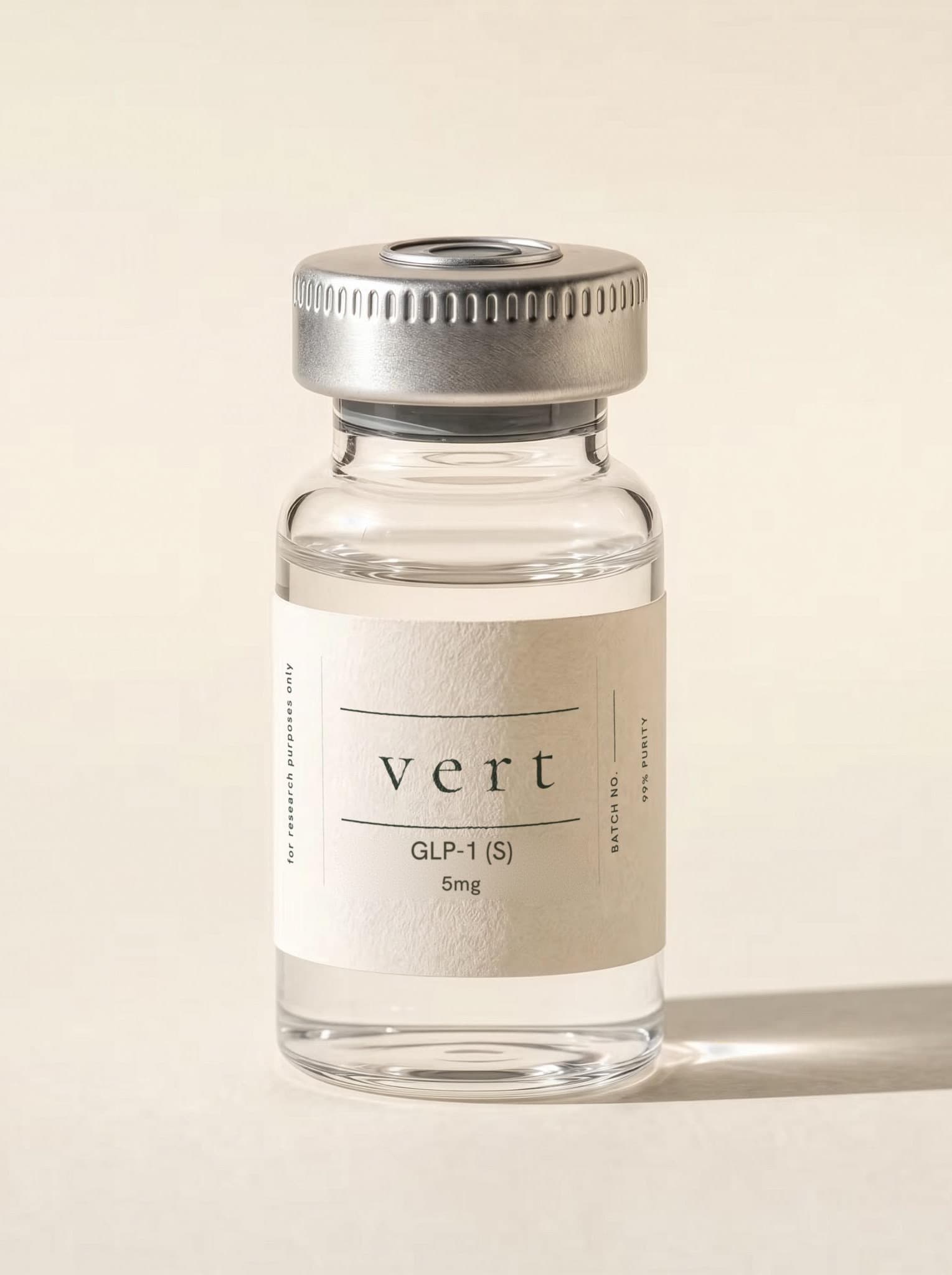
glp-1 (s)
GLP-1 receptor agonist
Research Use Only
from$119.95
All products are sold for research purposes only. We do not provide any guidance for personal use.
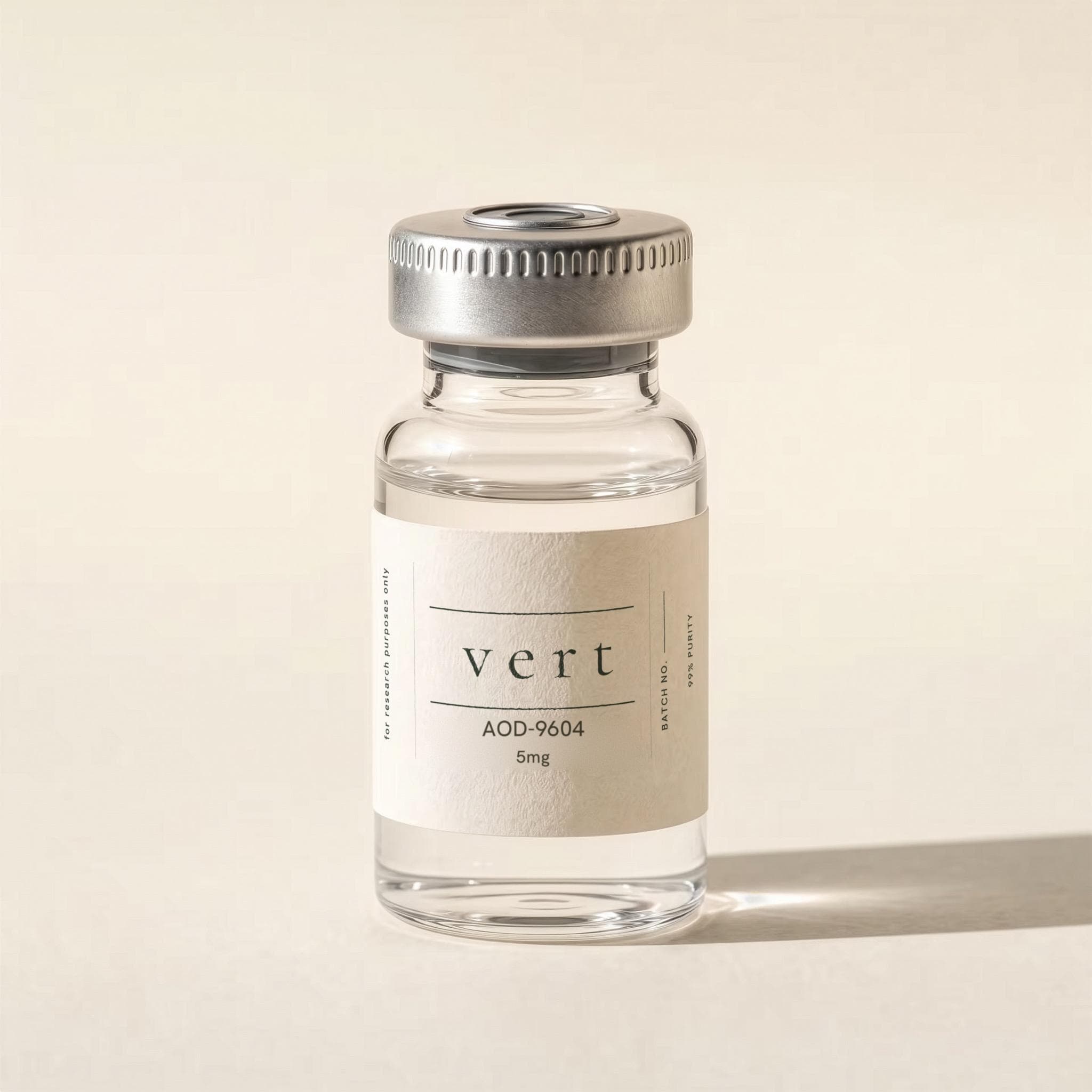
Modified C-terminal growth-hormone fragment
AOD-9604 is a synthetic peptide modeled on the C-terminal region of the growth-hormone sequence, supplied as a white lyophilized reference material in a single 5mg vial with a published certificate of analysis, and filed under the molecular formula C78H123N23O23S2 against PubChem CID 71300630.
AOD-9604 is a synthetic peptide built on the C-terminal region of the growth-hormone sequence and modified relative to it, which is why the catalog designates it a modified fragment rather than naming the parent sequence outright. The identity record for the material gives the molecular formula C78H123N23O23S2 at a molecular weight of approximately 1815.1 g/mol under PubChem CID 71300630, with the standard InChIKey GVIYUKXRXPXMQM-BPXGDYAESA-N filed against that record. The formula and the mass reconcile against each other exactly: summing standard atomic weights gives carbon 936.858, hydrogen 123.984, nitrogen 322.161, oxygen 367.977 and sulfur 64.120, which totals 1815.10 g/mol, matching the approximate mass carried for this compound. The designation AOD-9604 is an alphanumeric code and encodes nothing about the structure, so the identity of this material rests on the formula, the mass, the PubChem CID and the InChIKey rather than on the name. The certificate does not print a residue-by-residue sequence, and neither does this page. Investigated in laboratory research into growth-hormone signaling pathways. Supplied as a lyophilized reference material in one size, 5mg, described on its certificate as a white lyophilized powder; identity and purity are characterized by ultra-high-performance liquid chromatography with mass spectrometry against a specification of 98 percent minimum. It is not supplied as a solution, a suspension, or any other prepared formulation, and the specification fields on this page state which document each figure is read from.
>99% UPLC purity; identity confirmed by mass spectrometry. A Certificate of Analysis is published for each size, reporting that lot's identity and purity result. See our quality & COA page.
Supplied as a lyophilized reference material. Lyophilized reference materials are stored desiccated at 68°F (20°C), away from light and moisture. We do not provide reconstitution, preparation, or usage instructions of any kind.
AOD-9604 is a synthetic peptide built on the C-terminal region of the growth-hormone sequence, carrying a modification that distinguishes it from the corresponding stretch of the parent protein. That is what the word modified is doing in the chemical-class line: the material is a fragment-derived analogue, not an excerpt of growth hormone reproduced unchanged. Because the modification is what separates the two, a page that printed a residue-by-residue sequence without a document behind it would be publishing the least reliable part of the identity. The certificate does not print a sequence, so this page does not either. What it prints instead is the set of identifiers that fix the molecule: the molecular formula C78H123N23O23S2, a molecular weight of approximately 1815.1 g/mol, and PubChem CID 71300630, with the standard InChIKey GVIYUKXRXPXMQM-BPXGDYAESA-N filed against that record. The formula and the mass constrain the material; the CID and the InChIKey are what resolve it to a single chemical species.
The formula is C78H123N23O23S2 and the molecular weight is approximately 1815.1 g/mol, both filed against PubChem CID 71300630. The two are internally consistent, which is worth checking rather than assuming, because catalog listings for peptide reference materials routinely pair a formula with a mass that belongs to a different species or a different salt form. Summing standard atomic weights across the formula: 78 carbon at 12.011 gives 936.858, 123 hydrogen at 1.008 gives 123.984, 23 nitrogen at 14.007 gives 322.161, 23 oxygen at 15.999 gives 367.977, and 2 sulfur at 32.06 gives 64.120. The total is 1815.10 g/mol. The mass is carried as an approximate value for two good reasons. The final digit is sensitive to which set of standard atomic weights a calculation uses, so a figure a hundredth either side of that total is the same number. And an average molecular weight of this kind is not a monoisotopic mass; for a molecule of this size the two figures diverge, which is why a mass read off a spectrum will not land on 1815.1 exactly.
Use the registry identifiers, not the trade designation. AOD-9604 is an alphanumeric designation: it encodes nothing about the structure, and there is nothing in the string itself that can be checked against a registry. The identifiers can be. PubChem CID 71300630 resolves to one record. The standard InChIKey GVIYUKXRXPXMQM-BPXGDYAESA-N is a hashed structural fingerprint and is worth reading in parts. The leading block hashes the molecular skeleton, meaning connectivity alone. The block after it hashes the remaining layers, including stereochemistry. The practical consequence is that a stereochemically different material, one with an inverted centre, can share the leading block while differing in what follows, so an identity check that compares only the skeleton block is an incomplete check. Compare the whole key.
The certificate is published for the 5mg size at /coa/aod-9604-5mg.pdf. It states the appearance as a white lyophilized powder, and a purity specification of 98 percent minimum by ultra-high-performance liquid chromatography with mass spectrometry. Those two analytical techniques answer different questions. Mass spectrometry addresses identity, matching an observed molecular ion against the mass expected for the named species. A chromatographic purity number is an area-percent figure, the integrated area of the main peak over the total integrated peak area, which measures chromatographically resolved organic impurities in relative terms. Area-percent is not an assay of absolute content: it says nothing about water, residual solvent, counter-ion mass, or any species that fails to retain on the column or to absorb at the detection wavelength. Note also that a specification is a floor rather than a description of any particular vial, which is why this page cites the specification and leaves the per-lot figure to the document itself, where it sits beside the lot it belongs to. Anything the certificate does not state is not certified by it.
One size only, a 5mg vial, sealed and dry. The certificate describes the appearance as a white lyophilized powder. Lyophilization is freeze-drying: the material is frozen and the water is then drawn off by sublimation under reduced pressure, which leaves a light porous cake or powder rather than a compacted solid. It is supplied as dry reference material and nothing else. It is not a solution, not a suspension, not a premixed blend, and not any other prepared formulation. Because only one size is offered, there is a single certificate for this compound rather than a certificate per size.
Desiccated at 68°F (20°C), away from light and moisture, in the sealed vial it ships in. That is the storage condition v e r t states for this material as supplied, in its dry lyophilized state. Two of those three conditions matter for the same reason: a lyophilized peptide is hygroscopic, so an unsealed or repeatedly opened vial picks up atmospheric water, and the porous cake structure that makes the material easy to handle is also what gives that water a large surface to reach. Light exclusion is the ordinary precaution for lyophilized peptide reference materials held in clear glass. The 68°F figure is the condition stated for the sealed vial as shipped and held.
Laboratory research on this peptide is framed around growth-hormone signaling pathways, which is the class the material belongs to: the fragment it is built on comes from the C-terminal region of growth hormone, and the modification that distinguishes it from that region is the reason the material is studied as its own chemical entity rather than as a piece of the parent protein. This page names that pathway class and stops there. It does not describe what the compound produces in any living system, and it carries no literature citations.
FOR RESEARCH & EDUCATIONAL PURPOSES ONLY