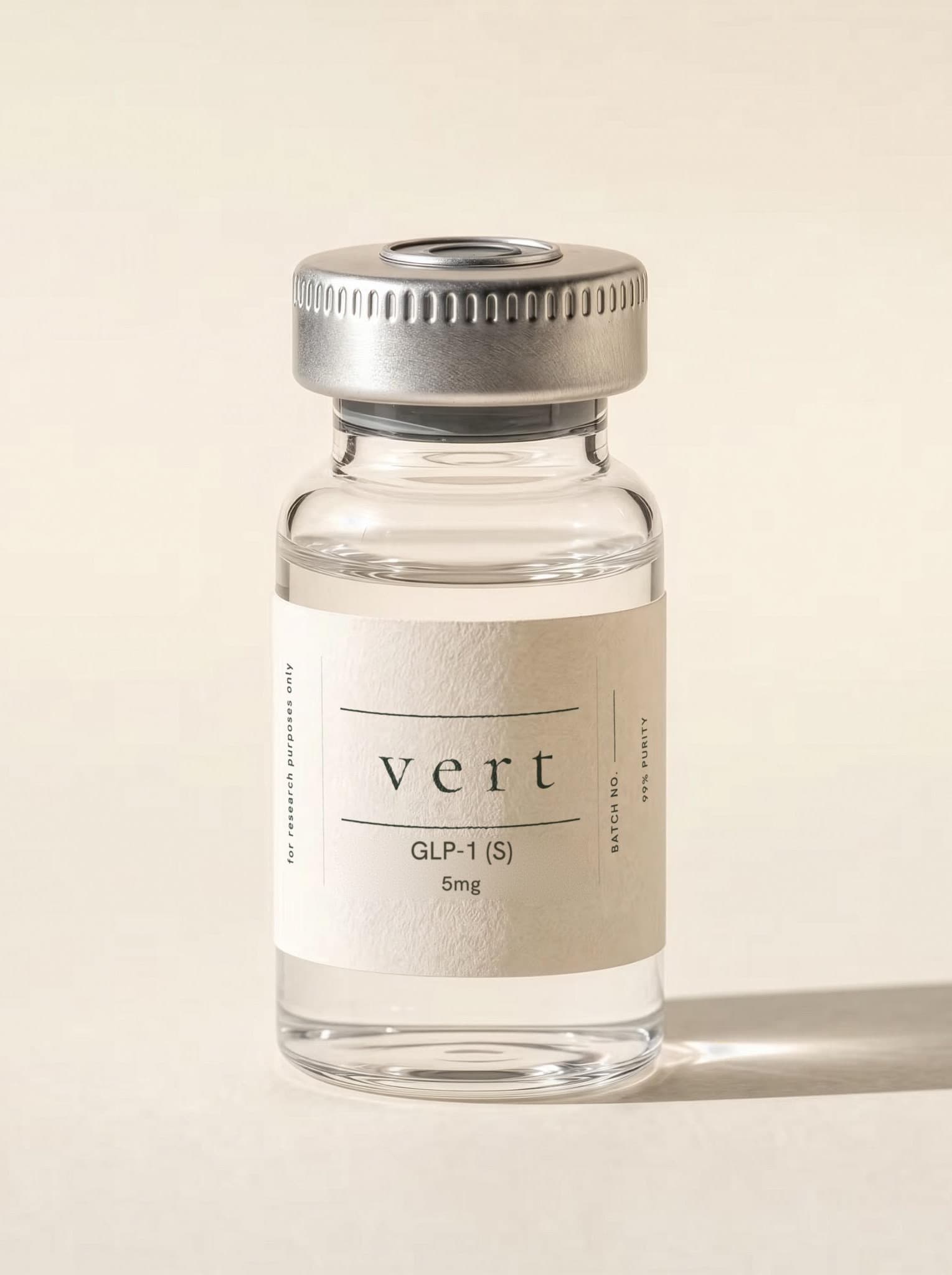
glp-1 (s)
GLP-1 receptor agonist
Research Use Only
from$119.95
All products are sold for research purposes only. We do not provide any guidance for personal use.
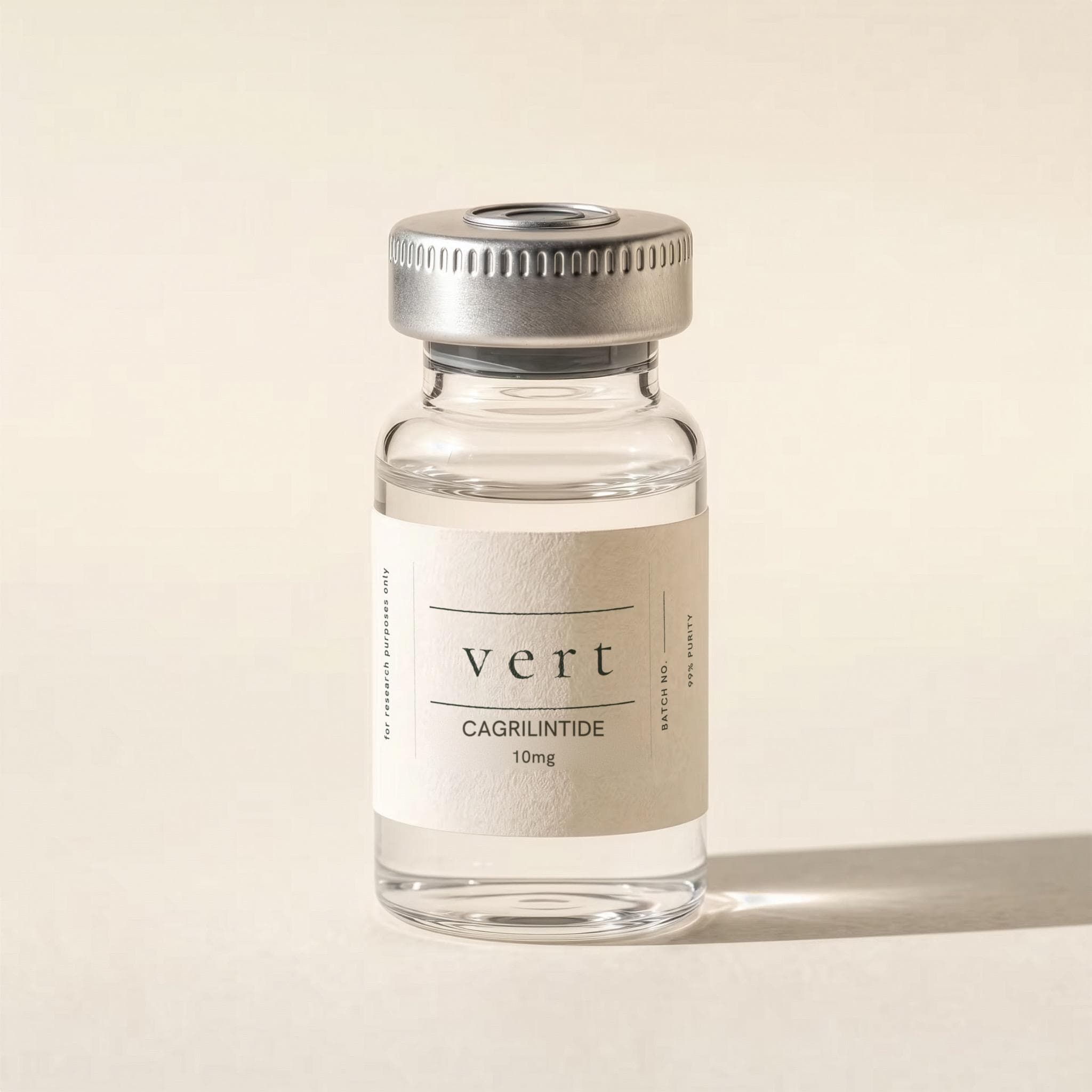
Long-acting amylin receptor agonist
Cagrilintide is a long-acting amylin receptor agonist peptide, molecular formula C194H312N54O59S2 at 4409 g/mol, supplied as a lyophilized reference material in a single 10mg vial with a published certificate of analysis.
Cagrilintide is a synthetic long-acting agonist peptide at the amylin receptor. Its molecular formula is C194H312N54O59S2, its molecular weight is 4409 g/mol, and the identity figures on this page are stated against PubChem CID 171397054 with the standard InChIKey LDERDVMBIYGIOI-IZVMHKDJSA-N. Formula and mass reconcile exactly: carbon 2330.13 plus hydrogen 314.50 plus nitrogen 756.38 plus oxygen 943.94 plus sulfur 64.12 sums to 4409.07 g/mol. Both figures are printed here together because that is the check worth running. A formula and a mass that fail to reconcile identify a listing error rather than a material. The formula resolves to 621 atoms drawn from five elements, and records no metal, no halogen and no phosphorus in the structure. Nitrogen accounts for 17.16 percent of formula mass across 54 atoms, the proportion an amide-linked backbone of this length produces, while the two sulfur atoms account for 1.45 percent. Investigated in laboratory research into amylin receptor signaling. Supplied as a lyophilized reference material in a single 10mg size, stated on the certificate as a white lyophilized powder. Identity and purity are characterized by ultra-high-performance liquid chromatography with mass spectrometry against a purity specification of 98 percent minimum, and the certificate for that size is published at /coa/cagrilintide-10mg.pdf. It is not supplied as a solution, a suspension, or any other prepared formulation.
>99% UPLC purity; identity confirmed by mass spectrometry. A Certificate of Analysis is published for each size, reporting that lot's identity and purity result. See our quality & COA page.
Supplied as a lyophilized reference material. Lyophilized reference materials are stored desiccated at 68°F (20°C), away from light and moisture. We do not provide reconstitution, preparation, or usage instructions of any kind.
Cagrilintide is a synthetic peptide classed as a long-acting amylin receptor agonist. On this page it is identified by molecular formula C194H312N54O59S2, molecular weight 4409 g/mol, PubChem CID 171397054, and standard InChIKey LDERDVMBIYGIOI-IZVMHKDJSA-N. Those four fields together are what pin a listing to one chemical species. A name alone does not, because catalog and trade names drift between suppliers while a formula, a mass, a database record and an InChIKey do not. v e r t stocks it in one size, 10mg, as a white lyophilized powder with a certificate of analysis published for that size.
The molecular formula is C194H312N54O59S2 and the molecular weight is 4409 g/mol, stated against PubChem CID 171397054. Those two figures are not independent of one another, and checking one against the other is the fastest way to catch a bad listing. Summing the formula from standard atomic weights gives carbon 194 x 12.011 = 2330.13, hydrogen 312 x 1.008 = 314.50, nitrogen 54 x 14.007 = 756.38, oxygen 59 x 15.999 = 943.94 and sulfur 2 x 32.06 = 64.12, for a total of 4409.07 g/mol, which reconciles with the record to the nearest gram per mole. Identity fields circulate badly for peptides of this size. A printed molecular weight off by an order of magnitude, or a database identifier pointing at an unrelated small molecule, both fail this arithmetic on sight. Where an identity field on any printed document disagrees with the record cited here, the figures on this page are the ones v e r t stands behind, and we would rather you asked us than relied on the other.
An InChIKey is a fixed-length hashed fingerprint of a structure, and its blocks each carry different information. The first block, LDERDVMBIYGIOI, is a 14-character hash of the molecular skeleton, meaning the connectivity of the atoms with stereochemistry set aside. The second block, IZVMHKDJ, is an 8-character hash of the remaining layers, chiefly stereochemistry and isotopic labelling. For a peptide carrying many defined stereocentres that is the block separating the intended structure from a stereoisomer of it, which is why two records can share a first block and still not describe the same substance. The letter S following that hash marks a standard InChIKey rather than one generated with non-default options, and the A after it is the InChI version indicator. The final character, N, is the protonation indicator and means the structure is recorded with no protonation change from the neutral parent. The hash runs one way only, so a key cannot be turned back into a structure. It is used to look one up, and to confirm that two records point at the same species.
C194H312N54O59S2 resolves to 621 atoms per formula unit, drawn from five elements. By formula mass the composition is carbon 52.85 percent, oxygen 21.41 percent, nitrogen 17.16 percent, hydrogen 7.13 percent and sulfur 1.45 percent. Two things follow directly. First, the nitrogen count of 54 atoms is what an amide-linked backbone of this length produces, since every peptide bond contributes a nitrogen while most side chains contribute none. Second, the formula records no metal, no halogen and no phosphorus, so the recorded structure is not a metal complex, not a halogenated analog and not a phosphorylated species. Those features are visible at a glance in a formula when they are present. The two sulfur atoms are the only sulfur-bearing content in the structure as recorded. At 4409 g/mol this molecule sits far above the tripeptides and nonapeptides elsewhere in this catalog, and that size is precisely why chromatographic resolution matters when the certificate is read.
A certificate is published for the 10mg size at a fixed public path, /coa/cagrilintide-10mg.pdf, and it carries the date its analysis was conducted. The method printed on the document is qualitative and quantitative chemical analysis by ultra-high-performance liquid chromatography with mass spectrometry, against a purity specification of 98 percent minimum. The two headline fields answer different questions. Mass spectrometry establishes identity: an observed molecular ion is compared against the expected mass of the named species. Chromatographic purity is an area-percent figure, the integrated area of the main peak divided by the total integrated peak area at the detection wavelength, which measures chromatographically resolved organic impurities against one another. Area-percent is not an assay of absolute content. It does not account for water, residual solvent, counter-ion mass, or any species that neither retains on the column nor absorbs at the detection wavelength. The document reports lot, identity, appearance, measured quantity against the nominal fill, purity and specification, alongside the analytical plates for that lot. It does not report water or moisture content, residual solvent, peptide content by nitrogen determination, endotoxin, or bioburden. Anything absent from the certificate is not certified by it.
Cagrilintide ships as a dry lyophilized reference material in a single sealed 10mg vial. The appearance stated on the certificate is a white lyophilized powder. Lyophilization is freeze-drying, water removed by sublimation from the frozen state under reduced pressure, which leaves a porous cake or powder rather than a compacted solid. That cake can settle or fracture in transit, which is a property of the drying method and not a signal about the material. Storage is desiccated at 68°F (20°C), away from light and moisture. It is not supplied as a solution, a suspension, a cream, or any other prepared formulation. Only one size is offered, so there is a single certificate to check rather than several.
FOR RESEARCH & EDUCATIONAL PURPOSES ONLY