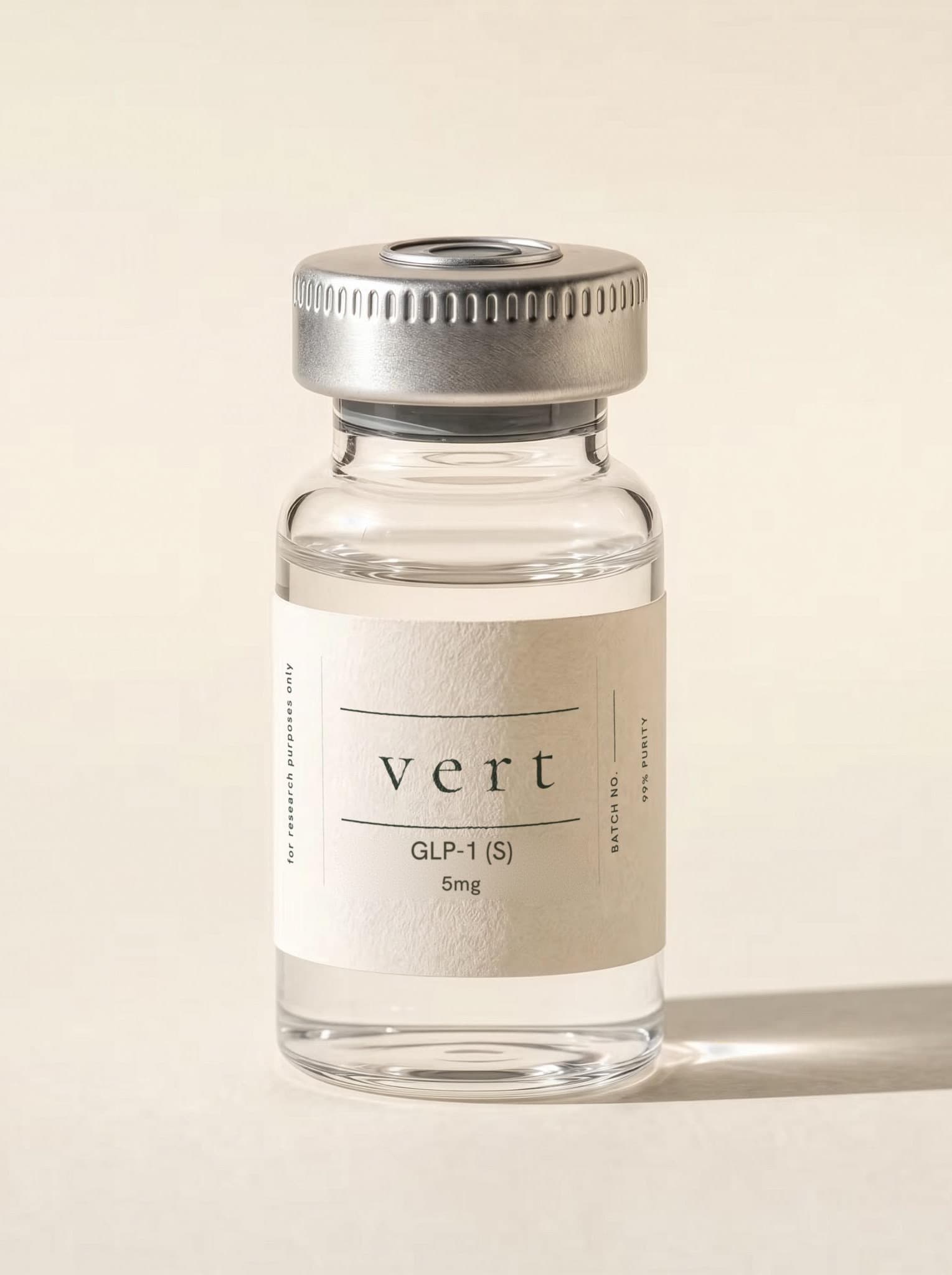
glp-1 (s)
GLP-1 receptor agonist
Research Use Only
from$119.95
All products are sold for research purposes only. We do not provide any guidance for personal use.
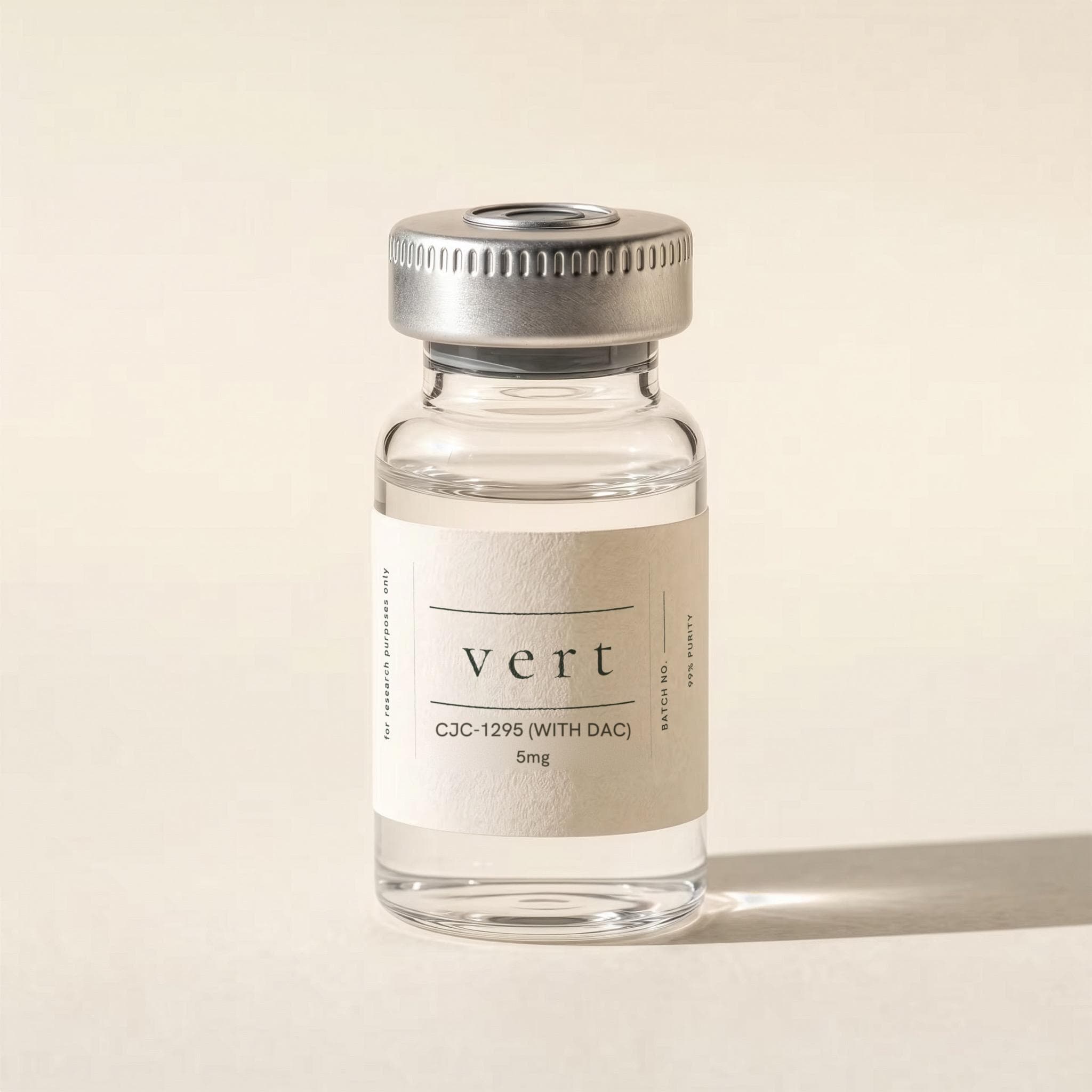
GHRH(1-29) analog, DAC
CJC-1295 (with DAC) is an albumin-binding synthetic analog built on the GHRH(1-29) scaffold, supplied as a lyophilized reference material in a single 5mg vial, molecular formula C165H269N47O46 at 3647.2 g/mol.
CJC-1295 (with DAC) is the albumin-binding member of the CJC-1295 pair that v e r t lists. Its scaffold is the 1-29 fragment of growth-hormone-releasing hormone, carried as a synthetic analog and extended with the conjugation the DAC in its name denotes: a Drug Affinity Complex, the albumin-binding group that separates this material from the unconjugated analog listed alongside it. The identity record on file gives the molecular formula C165H269N47O46 and a molecular weight of 3647.2 g/mol, indexed at PubChem CID 91971820 under the plain name CJC-1295, with the standard InChIKey ZUQGTWKGESAQCD-ZGFIGYLBSA-N. Those two figures reconcile against each other. Multiplied out against standard atomic weights, carbon at 165 times 12.011, hydrogen at 269 times 1.008, nitrogen at 47 times 14.007 and oxygen at 46 times 15.999, the formula sums to 3647.25 g/mol, which is the recorded 3647.2 to one decimal place. That sum is arithmetic performed here on the formula, not a second sourced figure. There is no sulfur atom in the formula at all, and that is a structural constraint rather than a stylistic detail: a construct whose formula carries no sulfur contains no cysteine and no methionine residue anywhere in it. Investigated in laboratory research into growth-hormone-releasing hormone receptor signaling. Supplied as a lyophilized reference material in one size, a sealed 5mg vial, stored desiccated at 68°F (20°C) away from light and moisture. It is not supplied as a solution, a cream, a serum, or any other prepared formulation. No certificate of analysis is published on this page for the 5mg size at present; v e r t certificates state ultra-high-performance liquid chromatography with mass spectrometry against a 98 percent minimum specification, and the current lot's document can be requested at contact@vertpeptides.com. No CAS registry number is printed on this page, because the identity record on file does not carry one.
>99% HPLC purity; identity confirmed by mass spectrometry. A Certificate of Analysis is available on request. See our quality & COA page.
Supplied as a lyophilized reference material. Lyophilized reference materials are stored desiccated at 68°F (20°C), away from light and moisture. We do not provide reconstitution, preparation, or usage instructions of any kind.
CJC-1295 (with DAC) is a synthetic analog built on the 1-29 fragment of growth-hormone-releasing hormone and carrying the conjugation its name denotes: a Drug Affinity Complex, an albumin-binding group. v e r t catalogs it as a GHRH(1-29) analog, DAC. The identity record on file gives molecular formula C165H269N47O46, molecular weight 3647.2 g/mol, PubChem CID 91971820 and the standard InChIKey ZUQGTWKGESAQCD-ZGFIGYLBSA-N. It is stocked in one size only, a 5mg lyophilized vial, as a reference material. Two things this page deliberately does not do. It does not print a CAS registry number, because the record on file does not carry one and a number copied from a competing listing is not a checked figure. And it does not describe an effect of any kind, because a reference-material listing is a statement about what is in the vial, not about what happens outside it. The identity block, the analytical method and the storage figure are the whole of what is being asserted here.
They are two different chemical entities that share a name, and across the industry that name is printed for both without qualification. v e r t lists them as separate products with separate pages, separate sizes and separate prices. The scaffold is common to both: a synthetic analog of the 1-29 fragment of growth-hormone-releasing hormone. What distinguishes this item is the Drug Affinity Complex conjugation, the albumin-binding group abbreviated DAC. Carrying that group necessarily alters the molecular formula and the molecular weight, so the conjugated material is a distinct chemical species rather than a variant of the same one. The practical consequence is that the name is the weakest identifier on the page and the formula is the strongest. This item is C165H269N47O46 at 3647.2 g/mol under PubChem CID 91971820. No figures for the unconjugated item are printed here or implied by these; read that item's own page for what is stated about it. Match the formula and the mass before you match the name.
The identity record on file carries the molecular formula C165H269N47O46 and a molecular weight of 3647.2 g/mol, and the two agree with each other. Multiplied out against standard atomic weights, carbon 165 times 12.011 gives 1981.815, hydrogen 269 times 1.008 gives 271.152, nitrogen 47 times 14.007 gives 658.329 and oxygen 46 times 15.999 gives 735.954, summing to 3647.25 g/mol, which is the recorded figure to one decimal place. That reconciliation is arithmetic done here on the formula and the standard atomic weights; it is not a second sourced number. The atom count itself is worth reading: 165 carbon, 269 hydrogen, 47 nitrogen, 46 oxygen, and no sulfur. The absence of sulfur is a hard structural constraint and not a rounding artifact, because a construct whose formula carries no sulfur atom contains no cysteine and no methionine residue anywhere in it.
Not one that is printed here. Public catalogs routinely show a CAS number against this material, and the identity record on file does not carry one, so this page prints nothing rather than repeating a figure that was never checked against the registry. What is printed is the set of identifiers the record does carry: molecular formula C165H269N47O46, molecular weight 3647.2 g/mol, PubChem CID 91971820, and the standard InChIKey ZUQGTWKGESAQCD-ZGFIGYLBSA-N. Those four together pin the material more tightly than a registry number does on its own. The InChIKey in particular is a fixed-length hash computed from the structure itself, so two records that share one describe the same connectivity and the same stereochemistry, wherever they are filed. A registry number carries none of that. It is an index entry assigned by a registry, and it is only as good as the record it points at. If a filing requires a CAS number, write to contact@vertpeptides.com rather than take a number scraped from a listing.
No certificate is published on this page for the 5mg size at present, and the page says so rather than linking a document that does not exist. The specification a v e r t certificate is read against is 98 percent minimum, and the stated method is ultra-high-performance liquid chromatography (UPLC) with mass spectrometry. Those are two questions answered by two separate measurements. The mass spectrometry plate speaks to identity: an observed molecular ion is compared against the expected mass of the named species, which for this material is 3647.2 g/mol. The chromatographic number speaks to purity, and it is an area-percent figure, the integrated area of the main peak divided by the total integrated peak area at the detection wavelength. Area-percent is relative, not absolute. It states how much of the chromatographically resolved, detectable material sits under the main peak, and it is not an assay of absolute content: it does not measure water, residual solvent, counter-ion mass, or any species that neither retains on the column nor absorbs at the detection wavelength. Anything a certificate does not state is not certified by it. To request the current lot's document, write to contact@vertpeptides.com.
It ships as a dry lyophilized reference material in a sealed vial, in one size only, 5mg. Lyophilization is freeze-drying: water is removed by sublimation directly from the frozen state under reduced pressure, which leaves a light porous cake rather than a compacted solid. That cake can settle, shift, or cling to the vial wall in transit, and its shape after shipping is not a purity signal. Storage is stated as desiccated at 68°F (20°C), away from light and moisture. That is the figure carried on v e r t documentation for this catalog, and it is reproduced here exactly as it is stated there rather than adjusted toward a general expectation. It is not supplied as a solution, a cream, a serum, or any other prepared formulation, and this page carries no preparation guidance of any kind.
FOR RESEARCH & EDUCATIONAL PURPOSES ONLY