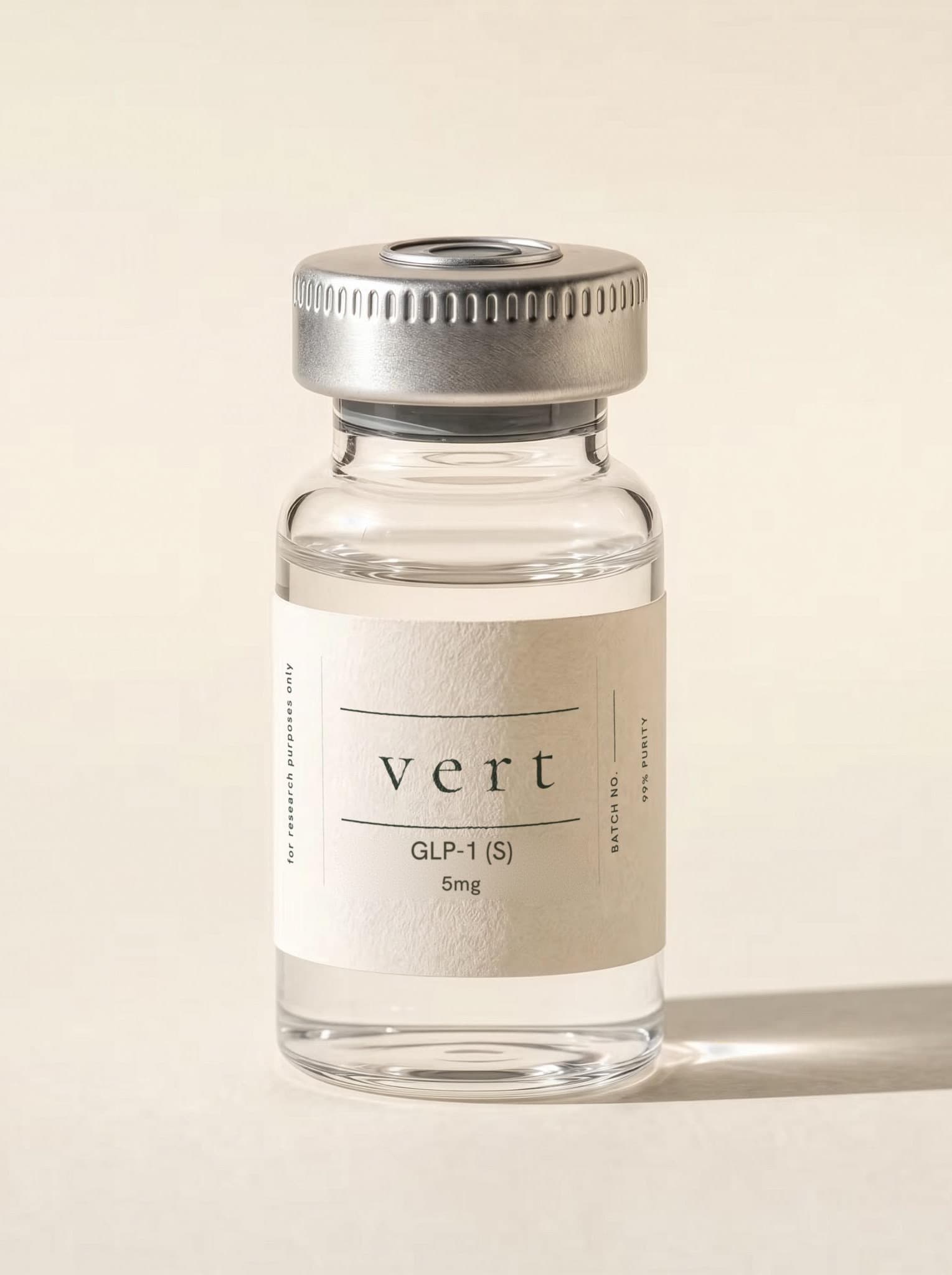
glp-1 (s)
GLP-1 receptor agonist
Research Use Only
from$119.95
All products are sold for research purposes only. We do not provide any guidance for personal use.
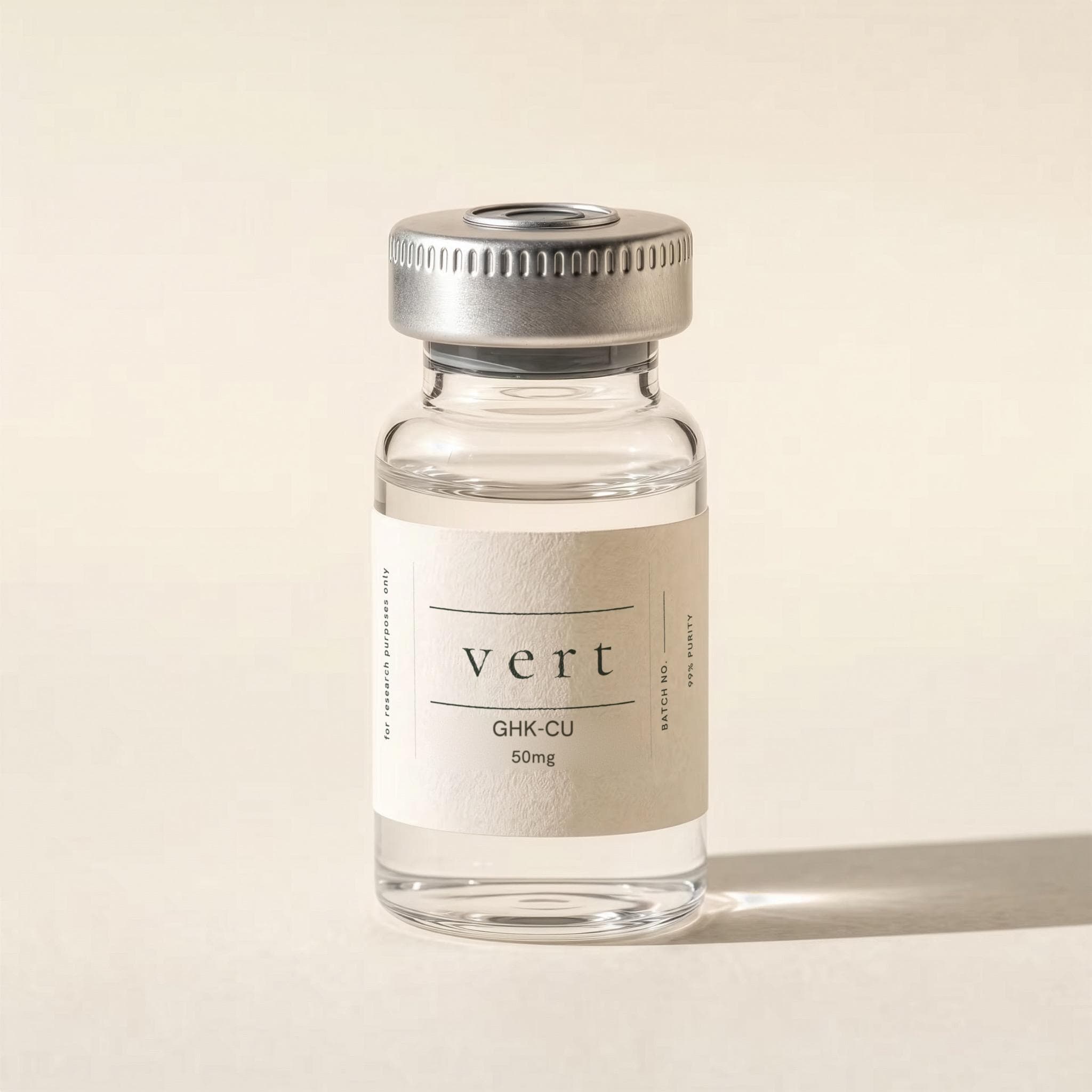
Copper(II)-tripeptide complex
GHK-Cu, also designated copper tripeptide-1, is the 1:1 copper(II) complex of the tripeptide glycyl-L-histidyl-L-lysine, supplied as a lyophilized reference material in 50mg and 100mg vials with a published certificate of analysis for each size.
GHK-Cu is the coordination complex formed when copper(II) binds the tripeptide glycyl-L-histidyl-L-lysine, sequence Gly-His-Lys, with histidine at the second of the three residues. The metal-free tripeptide is CAS 49557-75-7, C14H24N6O4, 340.38 g/mol. The copper complex carries its own registry number, CAS 89030-95-5, and the certificate published for each size prints the molecular formula C14H23CuN6O4 at approximately 402.92 g/mol against PubChem CID 71587328. The two masses reconcile exactly: add one copper atom (63.546) to the free tripeptide and remove one hydrogen (1.008), and 340.38 becomes 402.92, the arithmetic signature of a single deprotonation on metal binding. Copper(II) is held by a three-nitrogen donor set, being the alpha-amino nitrogen of the N-terminal glycine, the deprotonated amide nitrogen of the glycyl-histidyl peptide bond, and an imidazole nitrogen of the histidine side chain, while the lysine side-chain amine stays protonated and uncoordinated at neutral pH. Investigated in laboratory research into extracellular-matrix, matrix metalloproteinase and copper-coordination signaling pathways, and used in macromolecular crystallography as a copper-binding crystallization and phasing tag. Supplied as a lyophilized reference material in 50mg and 100mg vials; identity and purity characterized by ultra-high-performance liquid chromatography with mass spectrometry. It is not supplied as a solution, a cream, a serum, or any other prepared formulation. The specification fields on this page state which chemical species each figure describes.
>98% UPLC purity; identity confirmed by mass spectrometry. A Certificate of Analysis is published for each size, reporting that lot's identity and purity result. See our quality & COA page.
Supplied as a lyophilized reference material. Lyophilized reference materials are stored desiccated at 68°F (20°C), away from light and moisture. We do not provide reconstitution, preparation, or usage instructions of any kind.
GHK is the metal-free tripeptide glycyl-L-histidyl-L-lysine, CAS 49557-75-7. GHK-Cu is that same tripeptide holding one copper(II) ion in 1:1 stoichiometry, which makes it a distinct chemical species with its own registry number, CAS 89030-95-5. The difference is not simple addition. Coordination through three nitrogen atoms is accompanied by deprotonation of the backbone amide between the glycine and histidine residues, so the bound species is written CuH-1L in speciation notation and its formula carries one hydrogen fewer than the free peptide. The amino acid sequence is identical either way, Gly-His-Lys with histidine at position 2; nothing in the peptide backbone changes on binding except that one amide nitrogen, which is a consequence of coordination rather than a different peptide. Quoting the free peptide's molecular weight against a copper-complex lot, or the reverse, is the most common identity error on this compound.
Several masses circulate for this material and catalog listings routinely print one where another belongs, so a published figure has to say which species it describes. The metal-free tripeptide is C14H24N6O4 at 340.38 g/mol under CAS 49557-75-7. The copper complex is registered under CAS 89030-95-5, and the certificate published for each v e r t size prints the molecular formula C14H23CuN6O4 with a molecular weight of approximately 402.92 g/mol, referencing PubChem CID 71587328. That figure is internally consistent: carbon 168.154 plus hydrogen 23.184 plus copper 63.546 plus nitrogen 84.042 plus oxygen 63.996 sums to 402.92 g/mol. It also reconciles against the free peptide exactly, by adding one copper atom and removing one hydrogen. On those figures copper accounts for 15.8 percent of the formula mass. Read our own certificate rather than a third-party catalog listing for the formula and mass that describe the material in the vial.
Copper(II) sits in a three-nitrogen donor set: the alpha-amino nitrogen of the N-terminal glycine, the deprotonated amide nitrogen of the glycyl-histidyl peptide bond, and an imidazole nitrogen of the histidine side chain. Coordination of that backbone nitrogen requires deprotonation of the amide by the bound metal, which is why the bound form is written CuH-1L. The amine and amide donors close a five-membered chelate ring, the amide and imidazole donors a six-membered one. The lysine side-chain amine is not a donor atom at neutral pH, where it remains protonated; it takes part only under alkaline conditions. Because histidine sits at position 2 rather than position 3, GHK is not an ATCUN-type motif: that arrangement needs two preceding backbone amides and yields four nitrogen donors, as in DAHK, whereas GHK offers one preceding amide and yields three. In the 1.1 Angstrom crystal structure the coordination polyhedron is a distorted square pyramid of composition CuN3O2, with the four basal donor atoms at about 2.00 Angstrom and the apical donor at 2.49 Angstrom, the tetragonal elongation expected of a d9 copper(II) center. In that lattice the fourth and fifth donors are carboxyl oxygens contributed by two neighboring tripeptide units, so the solid is an intermolecularly bridged network rather than a set of discrete 1:1 molecules. In solution the picture is simpler: the complex is monomeric with the three-nitrogen set fixed, the remaining equatorial and apical positions filled by labile ligands such as water, and one site left open. The crystal structure is Perkins et al., Inorganica Chimica Acta 1984;82:93-99. Solution geometry was established by optical, EPR and electron spin-echo envelope spectroscopy (Freedman et al., Biochemistry 1982;21:4540-4544), and the EPR shows a seven-line nitrogen superhyperfine pattern, the signature of three coordinated nitrogens, with A-parallel 19.5 mT and g-parallel 2.21 (Laussac, Haran and Sarkar, Biochemical Journal 1983;209:533-539).
Potentiometric speciation of the binary system resolves CuH(GHK), Cu(GHK), CuH-1(GHK), CuH-2(GHK) and CuH2(GHK)2. For the 1:1 complex the conditional stability constant reported at pH 7.4 is 4.17 x 10^12 per molar, a conditional dissociation constant of 0.24 pM; at pH 6.5 the same constant falls to 4.79 x 10^10 per molar, or 20.9 pM, roughly a hundredfold weaker across less than one pH unit (Bossak-Ahmad et al., International Journal of Molecular Sciences 2020;21:6190). An independent isothermal titration calorimetry determination against a glycine competitor gives 7.0 plus or minus 1.0 x 10^-14 M at pH 7.4 (Trapaidze et al., Journal of Biological Inorganic Chemistry 2012;17:37-47). The two studies apply different competitor and correction schemes, so the defensible statement is a range near 0.07 to 0.24 pM rather than a single number. A 2:1 species, Cu(GHK)2, also forms but is orders of magnitude weaker, with a conditional constant of 237 plus or minus 5 per molar at pH 7.4. Because one coordination site stays open and labile, ternary species form readily at it: ternary copper(II) complexes with histidine and with cis-urocanic acid have both been characterized, and the cis-urocanic acid complex has a conditional constant of 540 plus or minus 17 per molar at pH 7.4, with the trans isomer binding about three times more weakly. Optical pH titration of the complex gives transitions at pKa 3.6, 9.2 and 11.4 (Freedman et al., 1982). Every constant above is conditional on the pH stated with it; figures quoted without their conditions are not comparable with these.
The copper complex is listed as copper tripeptide-1, its INCI cosmetic-ingredient designation, and as prezatide copper and glycyl-L-histidyl-L-lysine copper(II). The metal-free peptide is listed as tripeptide-1 under INCI and as prezatide under INN. Chemical databases carry the free peptide under the IUPAC name (2S)-6-amino-2-[[(2S)-2-[(2-aminoacetyl)amino]-3-(1H-imidazol-5-yl)propanoyl]amino]hexanoic acid, InChIKey MVORZMQFXBLMHM-QWRGUYRKSA-N, and isomeric SMILES C1=C(NC=N1)C[C@@H](C(=O)N[C@@H](CCCCN)C(=O)O)NC(=O)CN. Older registry records also carry two historical designations that are descriptive labels rather than structural names; they are not identity terms and are not used here. One practical caution: public synonym lists mix entries between the free-peptide record and the copper-complex record, so check which registry number a synonym is filed against before relying on it as identity.
GHK-Cu ships as a dry lyophilized reference material in a sealed vial, in two sizes, 50mg and 100mg. Lyophilization is freeze-drying, water removed by sublimation from the frozen state under reduced pressure, which leaves a porous cake or powder rather than a compacted solid. The material is blue; copper(II) complexes of this donor set are coloured. It is not supplied as a solution, a cream, a serum, or any other prepared formulation. Each size is analyzed separately and carries its own certificate.
A certificate is published for each size at a fixed public path, /coa/ghk-cu-50mg.pdf and /coa/ghk-cu-100mg.pdf, and each carries the date its analysis was conducted. The method printed on the document is qualitative and quantitative chemical analysis by ultra-high-performance liquid chromatography with mass spectrometry, against a purity specification of 98 percent minimum. The second page carries that lot's own data plates under the headings Mass Spectrometry and Ultra High Performance Liquid Chromatography, and those plates are generated per lot rather than templated. The two headline figures answer two different questions. Mass spectrometry establishes identity: the observed molecular ion corresponds to the expected mass of the named species. Chromatographic purity is an area-percent figure, the integrated area of the main peak divided by the total integrated peak area at the detection wavelength, which is a relative measure of chromatographically resolved organic impurities. Area-percent is not an assay of absolute content. It does not account for water, residual solvent, counter-ion mass, or any species that neither retains on the column nor absorbs at the detection wavelength. The document reports lot, identity, appearance, quantity, purity, CAS number, molecular formula, molecular weight and the analytical plates above. It does not report water or moisture content, residual solvent, an elemental copper assay, peptide content by nitrogen determination, endotoxin, or bioburden. Anything absent from the certificate is not certified by it.
The separation principle is the same. UPLC runs sub-2-micrometer stationary-phase particles at higher operating pressure than conventional HPLC, and the practical gain is narrower peaks, better resolution of closely eluting impurities, and shorter run times. A purity figure from either technique is still an area-percent figure and is read the same way, so the two method names on a certificate are not a difference in what the number means. The certificates published for GHK-Cu state UPLC with mass spectrometry.
The Gly-His-Lys triplet occurs within the alpha-2(I) chain of type I collagen and can be liberated from it by proteolysis. The matrix glycoprotein SPARC, also called osteonectin, has been reported as a second source of GHK and KGHK copper-binding fragments on proteolysis (Lane, Iruela-Arispe and Johnson, Journal of Cell Biology 1994;125:929-943). The tripeptide itself was first reported in 1973 by Pickart and Thaler. Its sequence was assigned as glycyl-histidyl-lysine four years later by Schlesinger, Pickart and Thaler, Experientia 1977;33:324-325. Those two dates are often collapsed into one: 1973 is when the peptide was reported, 1977 is when the sequence was pinned down.
Laboratory research on this complex has been framed around extracellular-matrix remodeling; matrix metalloproteinase systems including MMP-1, MMP-2 and MMP-9 together with the tissue inhibitors TIMP-1 and TIMP-2; collagen-related signaling and the small proteoglycan decorin; glycosaminoglycan systems including dermatan sulfate and chondroitin sulfate; TGF-beta signaling; NF-kB signaling including the p65 subunit; p38 MAPK signaling; integrin alpha-1 and integrin beta-1 adhesion signaling; VEGF and basic FGF signaling; and copper transport and copper homeostasis. Ternary copper(II) complexes of GHK with histidine and with cis-urocanic acid have been characterized in the coordination-chemistry literature. Separately from signaling work, the copper-binding tripeptide is used in macromolecular crystallography as a crystallization and phasing tag, where equimolar copper is sufficient for full site occupancy and the copper site shows radiation sensitivity in the 2 to 3 MGy range. These are the pathways and systems named in the literature, nothing more.
FOR RESEARCH & EDUCATIONAL PURPOSES ONLY