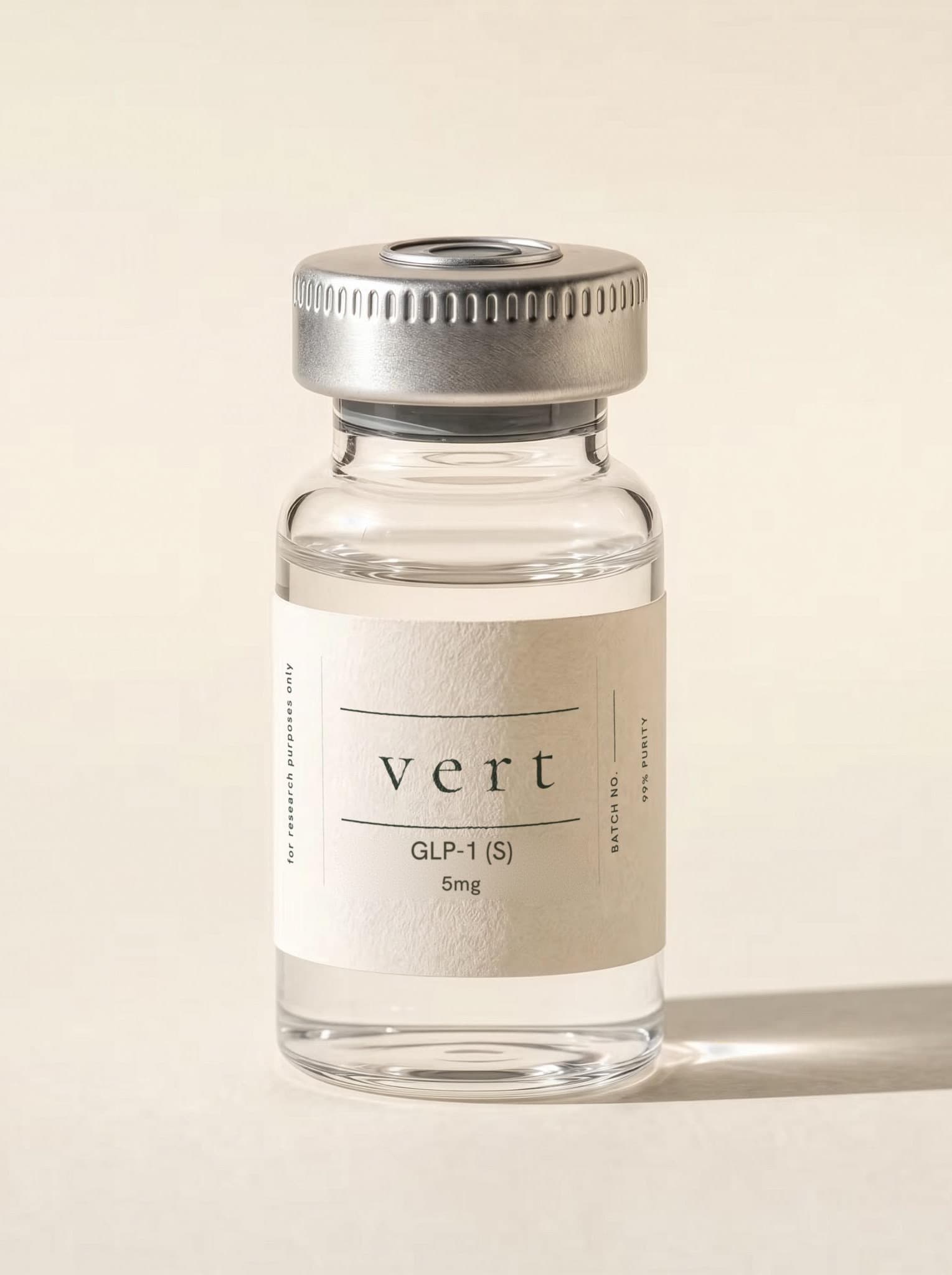
glp-1 (s)
GLP-1 receptor agonist
Research Use Only
from$119.95
All products are sold for research purposes only. We do not provide any guidance for personal use.
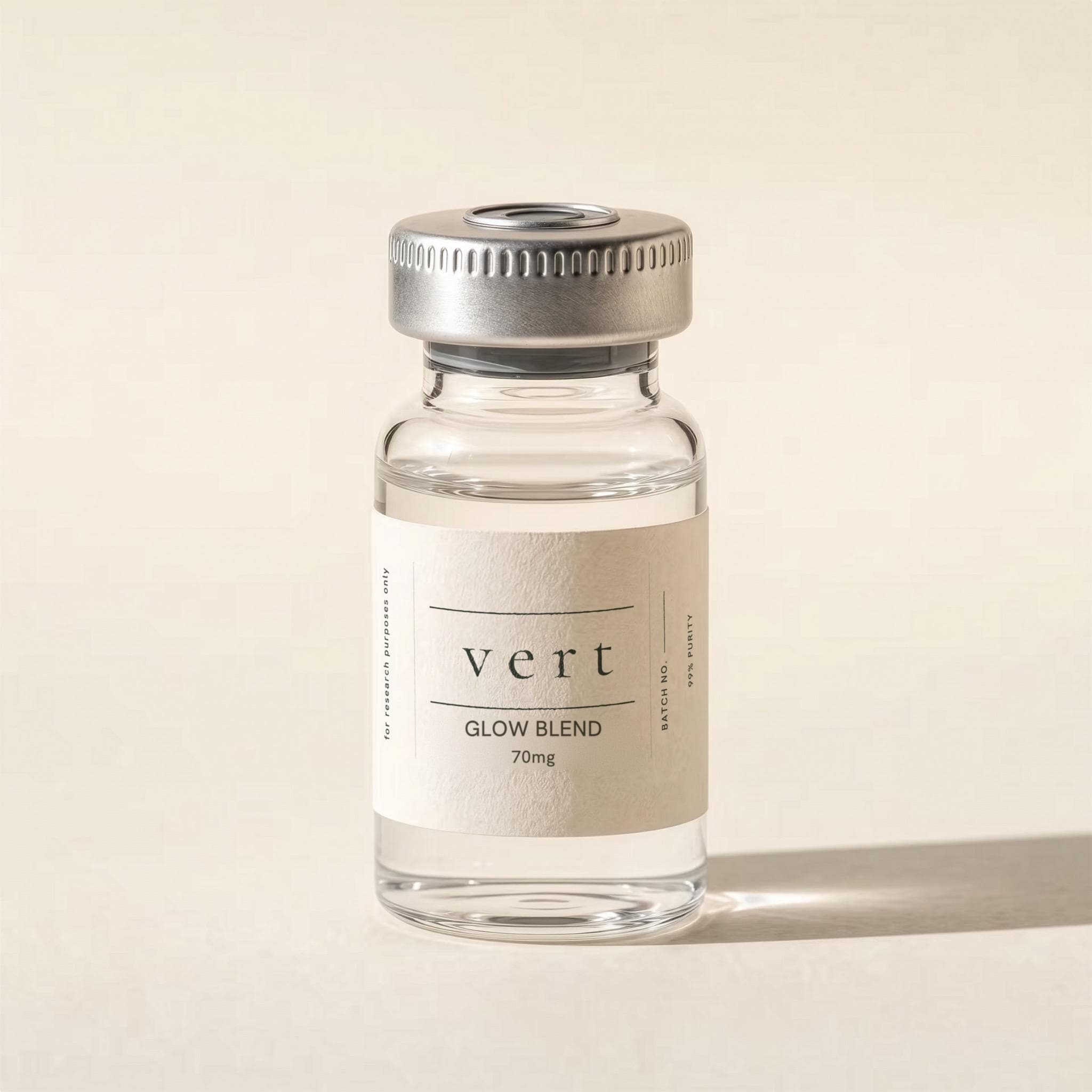
BPC-157 (10mg) + GHK-Cu (50mg) + TB-500 (10mg) — 70mg
Glow Blend is a pre-mixed three-compound reference material, BPC-157 at 10mg, GHK-Cu at 50mg and TB-500 at 10mg for a 70mg total, supplied lyophilized in a single vial with a certificate of analysis that identifies and tests each of the three components separately.
Research Use Only
View Certificate of Analysis (70mg (BPC10 + GHK-Cu50 + TB10))Quantity
Glow Blend is a pre-mixed combination of three separately manufactured compounds held in one vial: BPC-157 at 10mg, GHK-Cu at 50mg and TB-500 at 10mg, for a labeled total of 70mg. A mixture of three molecules has no molecular formula, no molecular weight and no CAS registry number of its own, so identity on this page is stated per component and never for the vial as a whole. Any single registry number attached to a blend describes one of its parts, not the mixture. The three components are chemically unrelated, and each keeps its own identity. BPC-157 is a synthetic pentadecapeptide, also designated PV-BPC 157, with molecular formula C62H98N16O22 and a molecular weight near 1419.5 g/mol. TB-500 is stated here against the full thymosin beta-4 sequence, molecular formula C212H350N56O78S at approximately 4963 g/mol, the complete parent protein rather than the shorter Ac-LKKTETQ fragment also sold under the TB-500 name. GHK-Cu is the third component, carried in its own section of the certificate with its own identity block. By mass the split is 1 to 5 to 1, BPC-157 to GHK-Cu to TB-500, so GHK-Cu accounts for roughly 71 percent of the 70mg total and each of the other two for roughly 14 percent. Both formula-and-mass pairs stated above reconcile against standard atomic masses: C62H98N16O22 sums to 1419.56, and C212H350N56O78S to 4963.51. Supplied as a lyophilized reference material in a single 70mg vial. Identity and purity are characterized by ultra-high-performance liquid chromatography with mass spectrometry, and the certificate published for this size is sectioned one part per component, each section carrying its own analysis against a purity specification of 98 percent minimum. It is not supplied as a solution, a cream, a serum, or any other prepared formulation. Stored desiccated at 68°F (20°C), away from light and moisture.
>99% UPLC purity; identity confirmed by mass spectrometry. A Certificate of Analysis is published for each size, reporting that lot's identity and purity result. See our quality & COA page.
Supplied as a lyophilized reference material. Lyophilized reference materials are stored desiccated at 68°F (20°C), away from light and moisture. We do not provide reconstitution, preparation, or usage instructions of any kind.
Glow Blend is one vial holding three separately manufactured compounds at labeled masses of BPC-157 10mg, GHK-Cu 50mg and TB-500 10mg, for a total of 70mg. The mass split is 1 to 5 to 1, so GHK-Cu is close to 71 percent of the labeled mass and the other two components are about 14 percent each. Anyone comparing this blend against a differently proportioned one should compare the component masses rather than the headline total, since two 70mg blends can hold entirely different amounts of each part.
A blend is a physical mixture, not a compound. Three distinct molecules sharing a vial share no structure, so there is no single molecular formula, molecular weight, InChIKey or CAS registry number that describes the contents. Each component keeps its own, and the certificate prints an identity block per section rather than one for the vial. This matters when reading any blend listing, ours included. A blend advertised with one CAS number is showing you a number that belongs to one of its parts, not a property of the mixture.
The certificate published for this size is not one test producing one figure. It is organized in sections, one per component, and each section carries that component's own identity block, appearance entry, measured quantity against the labeled quantity, purity value against the specification, and its own chromatogram and mass-spectrometry plates. The stated method is qualitative and quantitative chemical analysis by ultra-high-performance liquid chromatography with mass spectrometry, and the purity specification applied to each component is 98 percent minimum. The two headline figures answer different questions. Mass spectrometry establishes identity, matching an observed molecular ion against the expected mass for that component. Chromatographic purity is an area-percent figure, the main peak's integrated area divided by the total integrated peak area, a relative measure of chromatographically resolved organic impurities rather than an assay of absolute content. It does not account for water, residual solvent, counter-ion mass, or any species that neither retains on the column nor absorbs at the detection wavelength. The document reports lot, identity, appearance, quantity, purity and the analytical plates. It does not report moisture content, peptide content by nitrogen determination, endotoxin, or bioburden. Anything absent from the certificate is not certified by it.
No. Purity is reported per component, each measured on its own section of the certificate against the same 98 percent minimum specification. Quoting one section's figure as the purity of the blend is an error, and quoting the first section's figure is the most common version of that error, because the first section is what a reader or a scraper meets first. There is also no meaningful way to average the sections into one number: an area-percent purity figure describes chromatographic resolution within a single analysis of a single compound, so several such figures do not combine arithmetically into a property of the mixture. Read the section for the component you care about. The 98 percent minimum is the standing specification; the measured value on any given certificate belongs to the lot that certificate covers, and each certificate carries its own lot reference and analysis date.
Two different materials are sold under the TB-500 name: the complete thymosin beta-4 sequence, and the much shorter acetylated fragment Ac-LKKTETQ. They are not interchangeable, and their masses are not close. The TB-500 component in this blend is stated against full thymosin beta-4, molecular formula C212H350N56O78S at approximately 4963 g/mol, matching the public record for thymosin beta-4 under InChIKey UGPMCIBIHRSCBV-UHFFFAOYSA-N. We state the form our own certificate corresponds to and make no claim about the fragment. A listing quoting a mass far below this one under the TB-500 name is describing the fragment, not the full sequence.
A blend is a single vial holding all of its components together, covered by one certificate under one lot reference, with the component masses fixed by the mixture at the ratio printed on the label. A bundle is a set of separate vials packed and priced together, where each vial stays a discrete product with its own contents, its own lot and its own certificate. The distinction changes what you can document and what you can vary. In a blend the proportions are what they are; in a bundle each vial is independent. v e r t lists both, and this page is the blend: BPC-157, GHK-Cu and TB-500 pre-mixed in one 70mg vial.
Glow Blend ships as a dry lyophilized reference material in one sealed 70mg vial. Lyophilization is freeze-drying, water removed by sublimation from the frozen state under reduced pressure, which leaves a porous cake or powder rather than a compacted solid. Appearance is recorded on the certificate as white lyophilized powder. Storage is desiccated at 68°F (20°C), away from light and moisture. It is not supplied as a solution, a cream, a serum, or any other prepared formulation, and no preparation guidance is given here or anywhere else on this site.
FOR RESEARCH & EDUCATIONAL PURPOSES ONLY