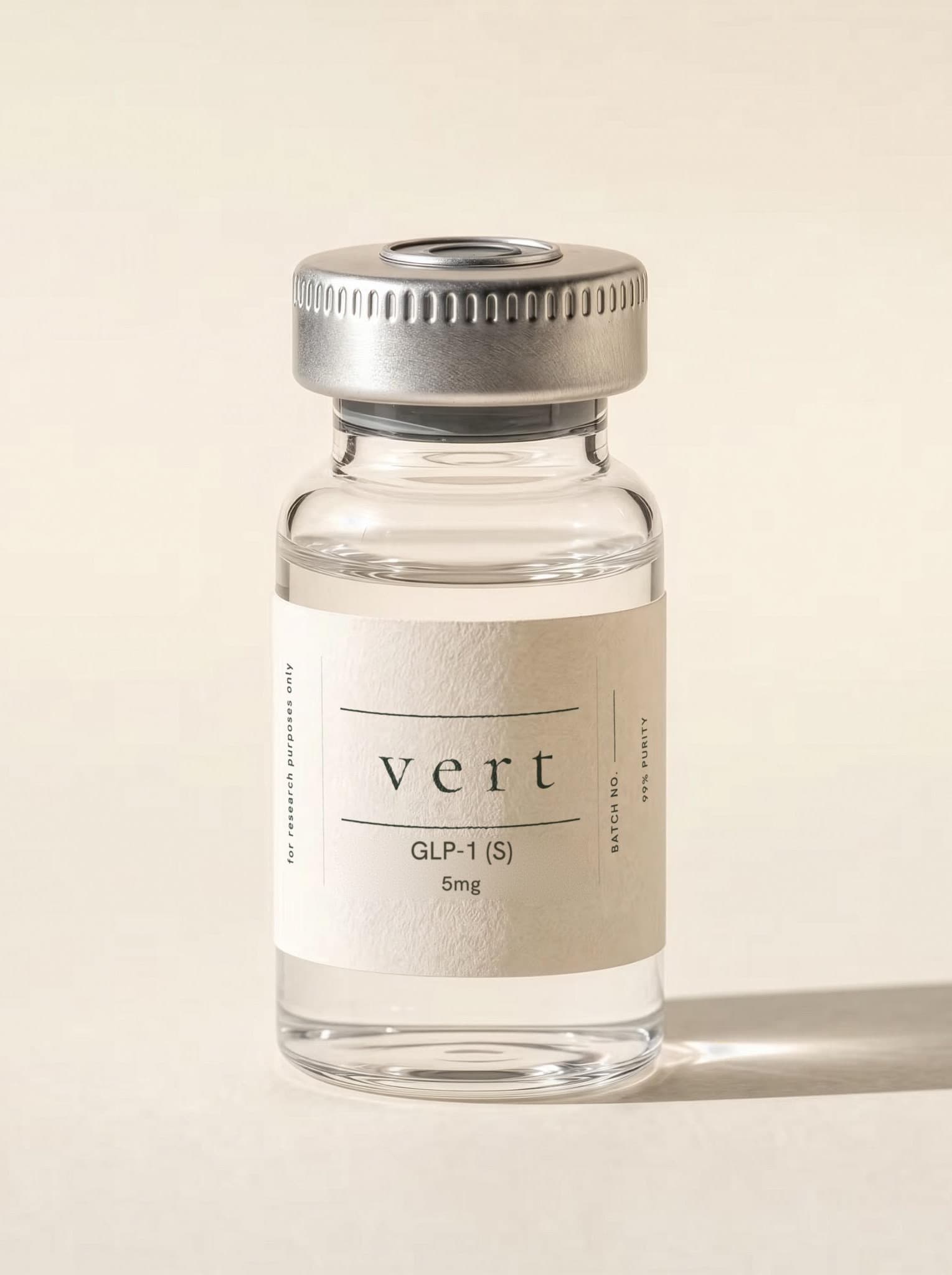
glp-1 (s)
GLP-1 receptor agonist
Research Use Only
from$119.95
All products are sold for research purposes only. We do not provide any guidance for personal use.
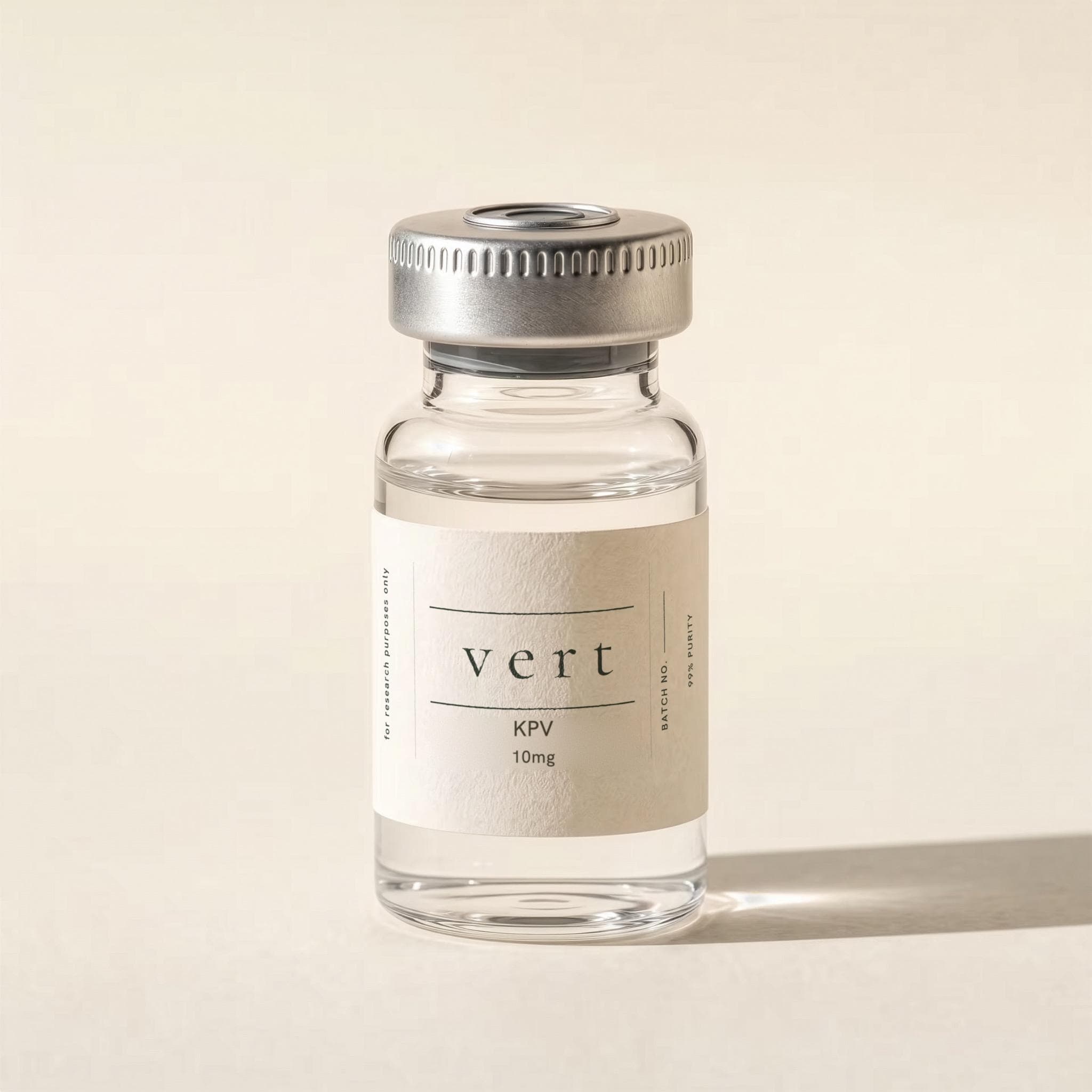
alpha-MSH(11-13) tripeptide fragment
KPV is the alpha-MSH(11-13) tripeptide fragment, sequence Lys-Pro-Val, supplied as a white lyophilized reference material in a single 10mg size with a published certificate of analysis.
KPV is a tripeptide of three residues, lysine, proline and valine, written Lys-Pro-Val in three-letter notation and KPV in the one-letter alphabet, where K stands for lysine, P for proline and V for valine. The sequence corresponds to positions 11 through 13 of alpha-melanocyte-stimulating hormone, alpha-MSH, which is why it is designated alpha-MSH(11-13). The parenthetical numbers in that designation are residue positions in the parent sequence, not a lot code or a concentration. Each residue contributes a different piece of chemistry. Lysine carries a four-carbon side chain ending in a primary amine, which is what gives the tripeptide a positive charge at neutral pH. Proline's side chain closes back onto the backbone nitrogen, forming a five-membered ring, so that position carries no backbone amide hydrogen. Valine closes the sequence with an aliphatic side chain branched at the carbon adjacent to the backbone. Three residues means two peptide bonds, and because the central residue is the cyclic one, the backbone carries a single ordinary amide hydrogen. Molecular weight and molecular formula for this material are stated on the certificate published for this size. Read them from that document rather than from this page or from a third-party catalog listing. As a melanocortin peptide fragment, KPV has been investigated in laboratory research into melanocortin signaling pathways. Supplied as a white lyophilized reference material in one size, 10mg. Identity and purity are characterized by ultra-high-performance liquid chromatography with mass spectrometry against a specification of 98 percent minimum, and the certificate is published at /coa/kpv-10mg.pdf. Stored desiccated at 68°F (20°C), away from light and moisture. It is not supplied as a solution, a cream, a spray, or any other prepared formulation.
>99% UPLC purity; identity confirmed by mass spectrometry. A Certificate of Analysis is available on request. See our quality & COA page.
Supplied as a lyophilized reference material. Lyophilized reference materials are stored desiccated at 68°F (20°C), away from light and moisture. We do not provide reconstitution, preparation, or usage instructions of any kind.
KPV is a tripeptide, a chain of three amino acid residues joined by two peptide bonds, with the sequence lysine-proline-valine. Written in the three-letter convention it is Lys-Pro-Val; written in the one-letter alphabet it is KPV, which is where the catalog name comes from. It is not an abbreviation of anything else. The same three residues occupy positions 11 through 13 of alpha-melanocyte-stimulating hormone, so the tripeptide is also designated alpha-MSH(11-13). v e r t supplies it as a lyophilized reference material for laboratory research and educational purposes only, in one size, with a certificate of analysis published for that size.
Alpha-melanocyte-stimulating hormone, usually shortened to alpha-MSH, is a melanocortin peptide, and KPV is a three-residue fragment of its sequence. The bracket notation alpha-MSH(11-13) is the standard way of naming a fragment: the numbers are positions counted from the N-terminus of the parent sequence, so (11-13) spans residue 11 to residue 13. Two things follow that are worth keeping straight. First, a fragment is a distinct chemical entity from the peptide it was named after, with its own database records; alpha-MSH figures do not describe KPV and should not be quoted against it. Second, fragment designations from different parent numbering conventions can collide, so the parent name always has to travel with the bracketed range.
Identity and purity are established by ultra-high-performance liquid chromatography with mass spectrometry. Mass spectrometry addresses identity, comparing the observed molecular ion against the expected value for the named species; chromatography addresses purity, and the figure it produces is an area-percent value, the integrated area of the main peak divided by the total integrated peak area at the detection wavelength. The certificate is published at a fixed public path, /coa/kpv-10mg.pdf, carries the date its analysis was conducted, and certifies against a purity specification of 98 percent minimum. It reports the lot, identity, appearance, quantity, purity, molecular formula and molecular weight, together with that lot's own analytical plates. What the certificate does not cover matters as much. An area-percent purity figure is a relative measure of chromatographically resolved organic impurities; it is not an assay of absolute content, and it does not account for water, residual solvent, counter-ion mass, or any species that neither retains on the column nor absorbs at the detection wavelength. The document does not report water or moisture content, residual solvent, peptide content by nitrogen determination, endotoxin, bioburden, or sterility. Anything absent from the certificate is not certified by it.
KPV ships as a dry lyophilized powder in a sealed vial, in a single size, 10mg. Lyophilization is freeze-drying: water is removed by sublimation from the frozen state under reduced pressure, which leaves a porous cake or powder rather than a compacted solid, and the certificate records the appearance as white. Storage is desiccated at 68°F (20°C), away from light and moisture. It is not supplied as a solution, a cream, a spray, or any other prepared formulation, and v e r t publishes no preparation or handling protocol of any kind alongside it.
The material is listed as KPV, as Lys-Pro-Val in three-letter residue notation, and as alpha-MSH(11-13) when named as a fragment of its parent sequence. Descriptive labels such as melanocortin tripeptide also appear in catalogs and in the literature; those describe the class and the provenance rather than fixing a structure, so they are not identity terms. One practical caution applies to any short peptide: public synonym lists routinely mix entries for modified and unmodified forms of the same sequence under a single heading, so check which registry or database record a synonym is filed against before relying on it as identity. The certificate published for this size is the reference for the material in the vial.
FOR RESEARCH & EDUCATIONAL PURPOSES ONLY