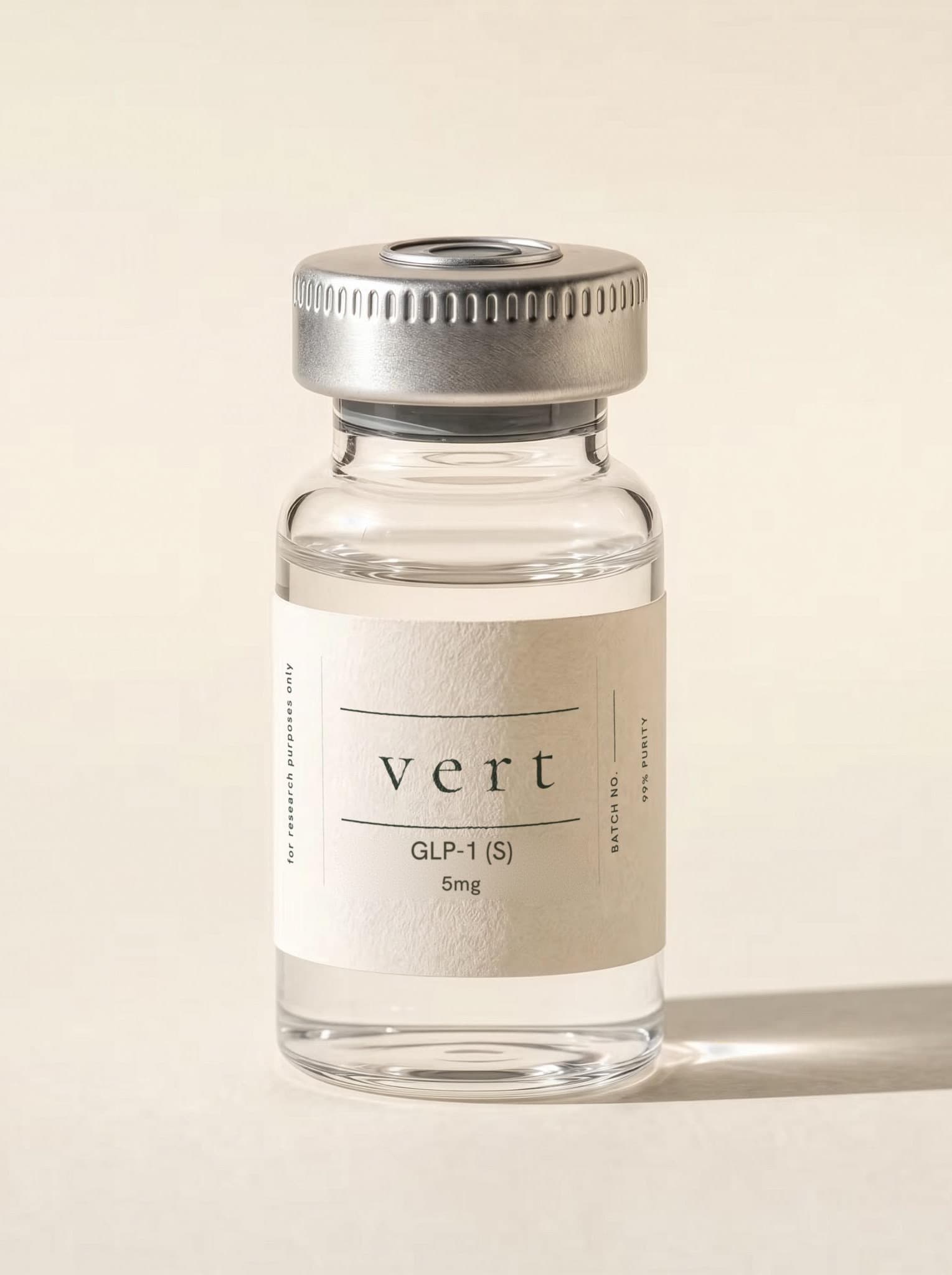
glp-1 (s)
GLP-1 receptor agonist
Research Use Only
from$119.95
All products are sold for research purposes only. We do not provide any guidance for personal use.
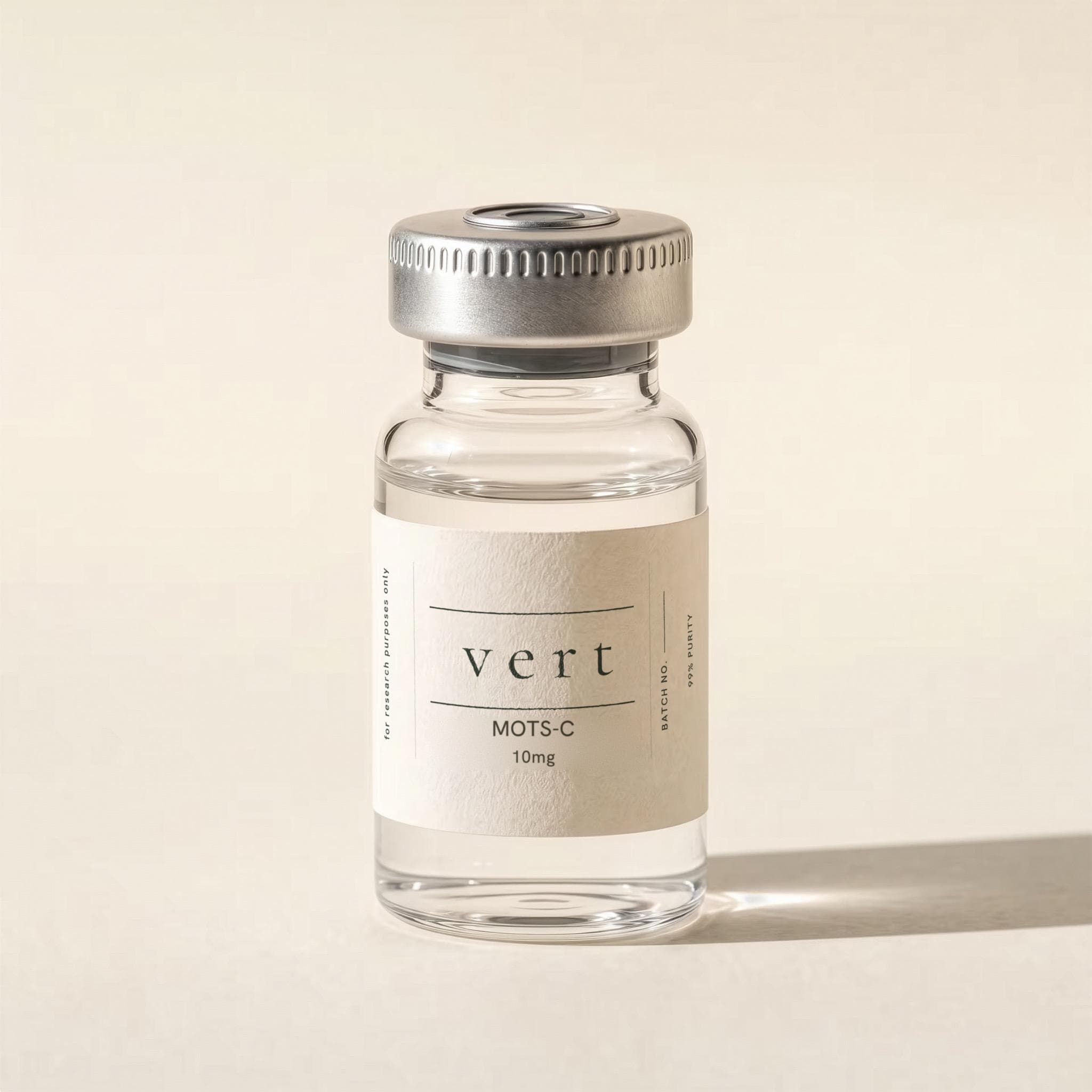
Mitochondrial-derived peptide
MOTS-c is a synthetic 16-amino-acid peptide modeled on the mitochondrial-derived MOTS-c sequence, supplied as a white lyophilized reference material in a single 10mg vial with a published certificate of analysis.
MOTS-c is supplied as a synthetic 16-amino-acid peptide modeled on the mitochondrial-derived MOTS-c sequence. Its class descriptor is mitochondrial-derived peptide, a label that records where the sequence it is modeled on was originally read from rather than anything about the chemistry of the material in the vial. The designation MOTS-c is an abbreviation rather than a descriptive chemical name, so it carries no structural information of its own and is not a substitute for the identity record below. The identity record v e r t holds for this material gives the molecular formula C101H152N28O22S2 and a molecular weight of 2174.6 g/mol against PubChem CID 146675088. Those two figures reconcile against each other, and the arithmetic is worth showing because catalog listings for long peptides frequently carry a formula that belongs to a different sequence. Multiplying the formula against standard atomic weights gives carbon 1213.11, hydrogen 153.22, nitrogen 392.20, oxygen 351.98 and sulfur 64.12, which sum to 2174.62 g/mol and round to the published 2174.6. A formula and a mass that agree to two decimal places are describing the same species. Beyond formula and mass, the identity anchors published here are that PubChem CID and the standard InChIKey WYTHCOXVWRKRAH-LOKRTKBUSA-N. No CAS registry number appears on the identity record v e r t holds for this material, so none is printed on this page. An InChIKey is a different kind of identifier from a registry number: it is a hash computed from the structure itself, so anyone holding the same structure can recompute it and confirm a match, whereas a registry number can only be looked up. Investigated in laboratory research into mitochondrial-derived peptide signaling. That is the research framing this listing carries, and this page names it and stops there. Supplied as a dry lyophilized reference material in a sealed vial, in one size, 10mg. Identity and purity are characterized by ultra-high-performance liquid chromatography with mass spectrometry, against a purity specification of 98 percent minimum. It is not supplied as a solution, a premixed vial, or any other prepared formulation, and the specification table on this page states which record each figure comes from.
>99% UPLC purity; identity confirmed by mass spectrometry. A Certificate of Analysis is published for each size, reporting that lot's identity and purity result. See our quality & COA page.
Supplied as a lyophilized reference material. Lyophilized reference materials are stored desiccated at 68°F (20°C), away from light and moisture. We do not provide reconstitution, preparation, or usage instructions of any kind.
MOTS-c is supplied here as a synthetic peptide of sixteen amino acid residues, modeled on the mitochondrial-derived MOTS-c sequence. The class descriptor carried on this listing, mitochondrial-derived peptide, is a statement about where the sequence it is modeled on was originally read from, not a claim about what the molecule is for and not a description of how the material in the vial was produced. What is in the vial is a synthetic reference material. The designation itself is an abbreviation rather than a descriptive chemical name, which means it tells a reader nothing about structure; the formula, mass, PubChem CID and InChIKey on this page are what actually identify the material.
The molecular formula is C101H152N28O22S2 and the molecular weight is 2174.6 g/mol, both from PubChem CID 146675088. For a peptide this long the figures are worth checking rather than copying, because a formula that belongs to a neighboring sequence will pass a casual read. These two check out against each other. Multiplying the formula against standard atomic weights gives carbon 1213.11, hydrogen 153.22, nitrogen 392.20, oxygen 351.98 and sulfur 64.12, which sum to 2174.62 g/mol and round to the published 2174.6. That is the only check this page publishes on those numbers, and it is an internal one: it confirms the formula and the mass describe the same species, and it says nothing about any particular vial. The purity specification and the certificate are what speak to the material itself.
None is printed on this page, because none appears on the identity record v e r t holds for this material. Where a registry number is absent from our own record, the honest option is an empty field rather than a number carried across from a third-party listing, since a wrong registry number is worse than no registry number: it silently points at a different substance and survives being copied. The identity of this material is instead anchored on two things that can be verified independently, PubChem CID 146675088 and the standard InChIKey WYTHCOXVWRKRAH-LOKRTKBUSA-N. Those are not equivalent kinds of identifier. A registry number is an assigned index entry, meaningful only by lookup. An InChIKey is a hash computed from the structure itself, so a reader holding the same structure can recompute the key and see whether it matches. If a listing elsewhere carries a CAS number for this peptide, check it against the registry directly before relying on it.
A certificate is published against the 10mg size at /coa/mots-c-10mg.pdf. The method stated is qualitative and quantitative chemical analysis by ultra-high-performance liquid chromatography with mass spectrometry, against a purity specification of 98 percent minimum, and appearance is recorded as a white lyophilized powder. The two headline figures answer different questions. Mass spectrometry establishes identity, by matching the observed molecular ion against the expected mass of the named species. Chromatographic purity is an area-percent figure, the integrated area of the main peak divided by the total integrated peak area at the detection wavelength, which is a relative measure of chromatographically resolved organic impurities. Area-percent is not an assay of absolute content: it does not account for water, residual solvent, counter-ion mass, or any species that neither retains on the column nor absorbs at the detection wavelength. The document does not report water or moisture content, residual solvent, peptide content by nitrogen determination, endotoxin, or bioburden. Anything absent from the certificate is not certified by it. Purity results are specific to the lot they were run on, so read the published document rather than any headline figure on a catalog page.
One size, 10mg, shipped as a dry lyophilized reference material in a sealed vial. Lyophilization is freeze-drying, water removed by sublimation from the frozen state under reduced pressure, which leaves a porous cake or powder rather than a compacted solid; the certificate records the appearance as a white lyophilized powder. Store desiccated at 68°F (20°C), away from light and moisture. The material is not supplied as a solution, a premixed vial, or any other prepared formulation, and no preparation guidance of any kind is provided with it or available on request.
FOR RESEARCH & EDUCATIONAL PURPOSES ONLY