glp-1 (s)
GLP-1 receptor agonist
Research Use Only
from$119.95
All products are sold for research purposes only. We do not provide any guidance for personal use.
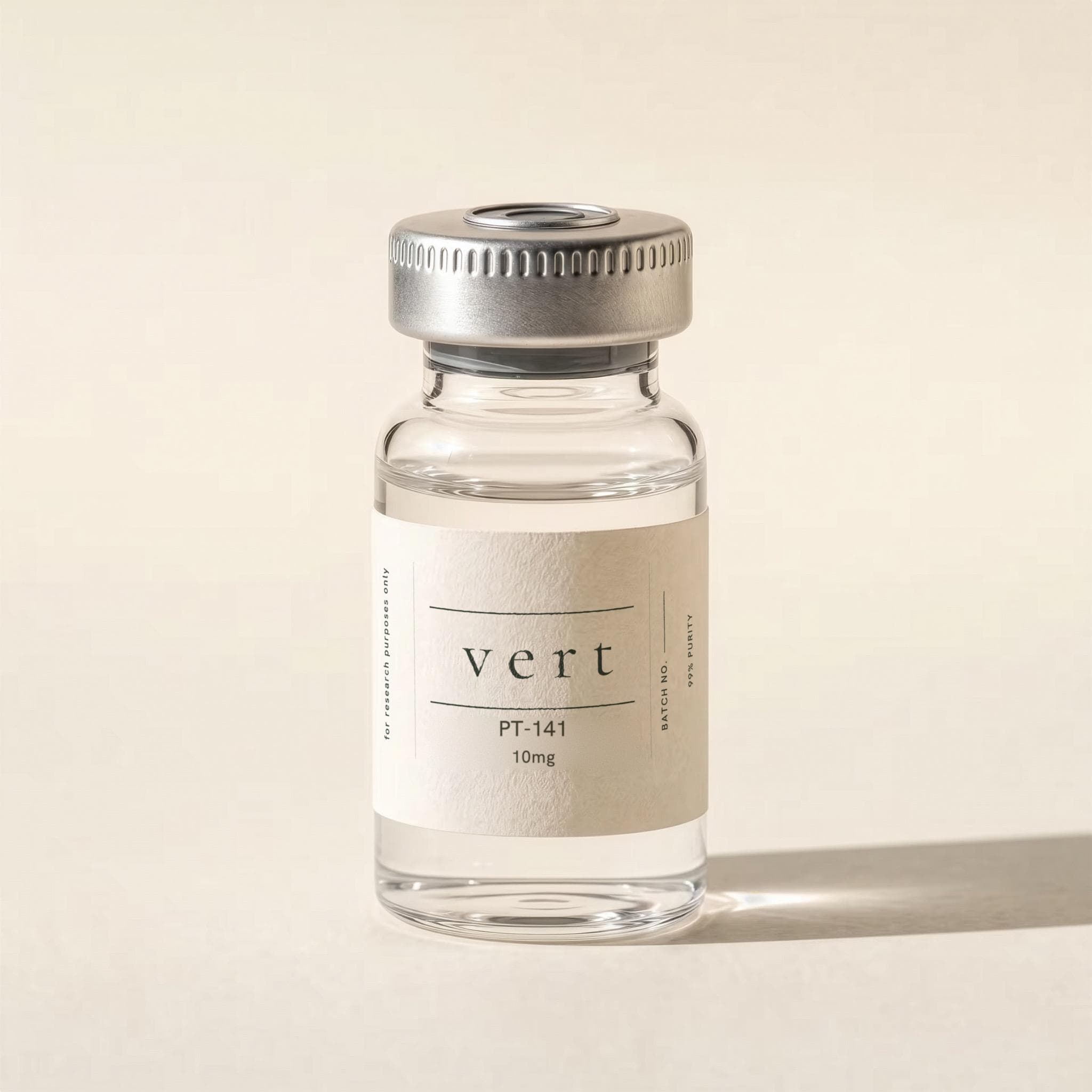
Cyclic heptapeptide melanocortin receptor agonist
PT-141, filed in PubChem under the name bremelanotide as CID 9941379, is a cyclic heptapeptide melanocortin receptor agonist supplied as a white lyophilized reference material in a single 10mg vial with a published certificate of analysis.
PT-141 is a cyclic heptapeptide of the melanocortin receptor agonist class, filed in PubChem under the name bremelanotide as CID 9941379. Its molecular formula is C50H68N14O10 and its molecular weight is 1025.2 g/mol. Those two figures reconcile against each other exactly: fifty carbon atoms at 12.011 contribute 600.55, sixty-eight hydrogens at 1.008 contribute 68.54, fourteen nitrogens at 14.007 contribute 196.10, and ten oxygens at 15.999 contribute 159.99, summing to 1025.18 g/mol across 142 atoms in all. The standard InChIKey is FFHBJDQSGDNCIV-MFVUMRCOSA-N. An InChIKey is a fixed-length hash rather than a name, and its blocks are readable in isolation: the first fourteen characters hash the molecular skeleton and its connectivity, the eight that follow the hyphen hash the remaining layers including stereochemistry, the S marks it a standard InChI, the A gives the InChI version, and the trailing N records a neutral protonation state. Investigated in laboratory research into melanocortin receptor signaling pathways. Supplied as a lyophilized reference material in one size, a sealed 10mg vial, with the appearance recorded on its certificate as white lyophilized powder. Identity and purity are characterized by ultra-high-performance liquid chromatography with mass spectrometry against a purity specification of 98 percent minimum. It is not supplied as a solution, a suspension, or any other prepared formulation, and it is stored desiccated at 68°F (20°C), away from light and moisture.
>99% UPLC purity; identity confirmed by mass spectrometry. A Certificate of Analysis is published for each size, reporting that lot's identity and purity result. See our quality & COA page.
Supplied as a lyophilized reference material. Lyophilized reference materials are stored desiccated at 68°F (20°C), away from light and moisture. We do not provide reconstitution, preparation, or usage instructions of any kind.
PT-141 is a cyclic heptapeptide of the melanocortin receptor agonist class, supplied by v e r t as a dry reference material. Chemical databases file the same structure under the name bremelanotide, at PubChem CID 9941379, with the molecular formula C50H68N14O10, a molecular weight of 1025.2 g/mol, and the standard InChIKey FFHBJDQSGDNCIV-MFVUMRCOSA-N. Cyclic here is structural rather than descriptive: the backbone closes on itself rather than running end to end as a linear chain, which is what separates a cyclic peptide from a straight sequence of the same length. Seven residues make it a heptapeptide. Melanocortin receptor agonist names the receptor family the molecule is characterized against; it is a class descriptor, not a statement of what the compound produces in any living system.
The formula is C50H68N14O10 and the molecular weight is 1025.2 g/mol, filed at PubChem CID 9941379 under the name bremelanotide, with standard InChIKey FFHBJDQSGDNCIV-MFVUMRCOSA-N. Those two numeric figures are internally consistent and can be checked without leaving this page. Using standard atomic weights, fifty carbons at 12.011 give 600.55, sixty-eight hydrogens at 1.008 give 68.54, fourteen nitrogens at 14.007 give 196.10, and ten oxygens at 15.999 give 159.99. The sum is 1025.18 g/mol, which is the 1025.2 figure to one decimal place. A stated mass that fails to reconcile with its own stated formula is describing a different species, a different salt form, or a transcription error, so the arithmetic is worth carrying out. For any registry identifier not printed above, the published certificate is the document to read.
An InChIKey is a fixed-length hash of a structure, not a name, which is why it is the most reliable single identifier to compare across catalogs, databases and certificates. It has three blocks. FFHBJDQSGDNCIV, the first fourteen characters, hashes the molecular skeleton, meaning the atoms and how they are connected but not their arrangement in space. MFVUMRCO, the eight characters after the first hyphen, hashes the remaining layers, of which stereochemistry is the significant one for a peptide, since every chiral center in every residue is encoded here. The S that follows marks the key as a standard InChI, generated with default settings rather than custom ones, and the A gives the InChI version. The final N, after the second hyphen, records a neutral protonation state. The practical consequence is that two materials sharing the first block are the same skeleton, and if their second blocks differ they are stereoisomers of one another rather than the same compound. For a seven-residue peptide with multiple chiral centers that distinction is not cosmetic, and a listing that matches on the skeleton block alone has not been shown to match on stereochemistry.
The certificate is published at a fixed public path, /coa/pt-141-10mg.pdf. The stated method is qualitative and quantitative chemical analysis by ultra-high-performance liquid chromatography with mass spectrometry, and the specification it is judged against is 98 percent minimum. Purity and identity are two different findings from that one document. Mass spectrometry establishes identity by matching an observed molecular ion to the mass expected for C50H68N14O10. The purity figure is an area-percent measure, the integrated area of the main chromatographic peak over the total integrated peak area, which quantifies chromatographically resolved organic impurities relative to the main species. Area-percent is not an assay of absolute content: it does not account for water, residual solvent, counter-ion or salt mass, or any species that fails to retain on the column or to absorb at the detection wavelength. The document does not report moisture content, residual solvent, peptide content by nitrogen determination, endotoxin, or bioburden. Anything the certificate does not state is not certified by it. Purity is a per-lot finding, so the figure this page prints is the standing 98 percent minimum specification; the certificate posted for the size in the vial is the authority for the material in hand.
PT-141 ships as a dry lyophilized reference material in a single sealed vial at one size, 10mg. Lyophilization is freeze-drying, in which water is removed by sublimation from the frozen state under reduced pressure; what it leaves behind is a light porous cake or powder rather than a dense compacted solid, and the cake can look uneven or partly collapsed without that indicating anything about purity. The certificate records the appearance as white lyophilized powder. The material is not supplied as a solution, a suspension, a gel, or any other prepared formulation. Storage is desiccated at 68°F (20°C), away from light and moisture, in the sealed vial as received.
FOR RESEARCH & EDUCATIONAL PURPOSES ONLY