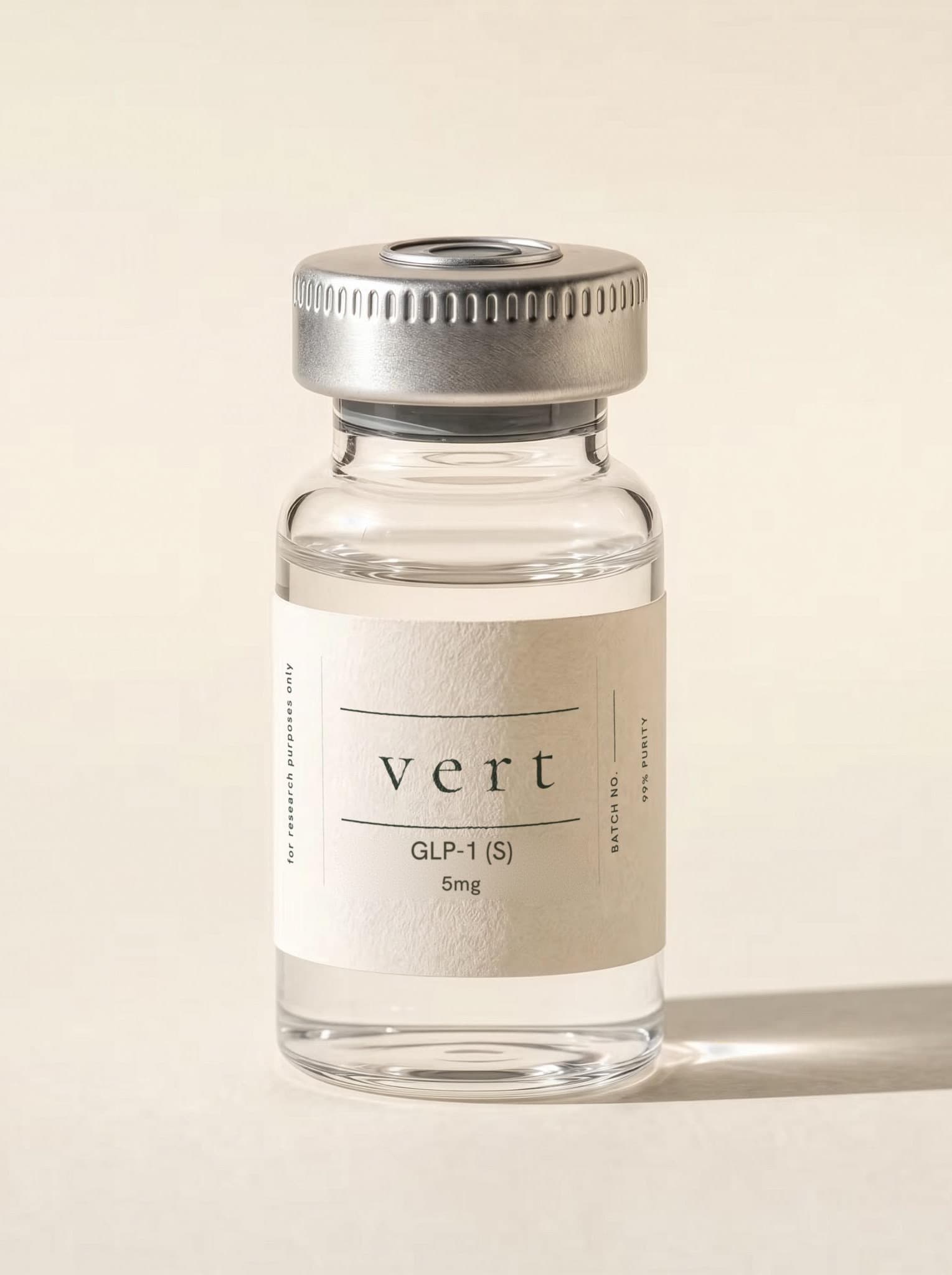
glp-1 (s)
GLP-1 receptor agonist
Research Use Only
from$119.95
All products are sold for research purposes only. We do not provide any guidance for personal use.
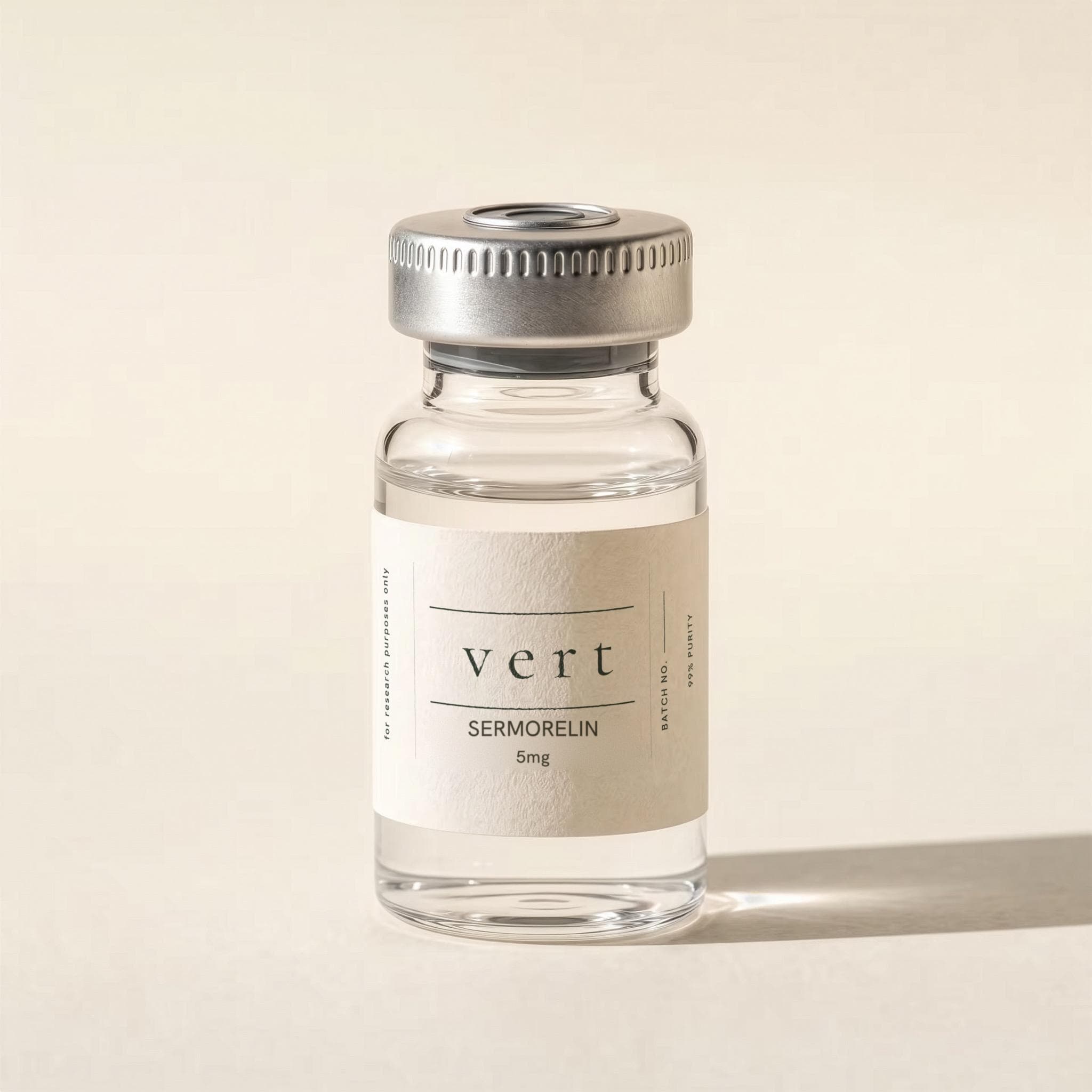
GRF(1-29) GHRH analog
Sermorelin is the GRF(1-29) analog of growth hormone-releasing hormone, molecular formula C149H246N44O42S at approximately 3357.9 g/mol, supplied as a 5mg lyophilized reference material with a published certificate of analysis.
Sermorelin corresponds to the first twenty-nine residues of growth hormone-releasing hormone, carried as a single linear chain, and it is catalogued under the designation GRF(1-29). The certificate published for the 5mg size prints the molecular formula C149H246N44O42S and a molecular weight of approximately 3357.9 g/mol. Those two figures are internally consistent, and the check can be run without leaving this page: on standard atomic weights, 149 carbon contributes 1789.639, 246 hydrogen contributes 247.968, 44 nitrogen contributes 616.308, 42 oxygen contributes 671.958 and the single sulfur contributes 32.06, summing to 3357.9 g/mol. One structural feature is legible in that formula on its own terms. The chain carries exactly one sulfur atom, and a disulfide bridge requires two, so there is no bridge in this material: no cyclic alternative, and none of the reduced-versus-oxidized ambiguity that bridged peptides bring to an analytical record. Sermorelin is linear, and its chromatogram has one parent peak to account for. Investigated in laboratory research into growth hormone-releasing hormone signaling. Supplied as a white lyophilized powder in a single 5mg vial, stored desiccated at 68°F (20°C) away from light and moisture. Identity and purity are characterized by ultra-high-performance liquid chromatography with mass spectrometry, against a purity specification of 98 percent minimum. It is not supplied as a solution or as any other prepared formulation, and no preparation guidance is given on this page.
>99% UPLC purity; identity confirmed by mass spectrometry. A Certificate of Analysis is published for each size, reporting that lot's identity and purity result. See our quality & COA page.
Supplied as a lyophilized reference material. Lyophilized reference materials are stored desiccated at 68°F (20°C), away from light and moisture. We do not provide reconstitution, preparation, or usage instructions of any kind.
Sermorelin is a linear peptide corresponding to the first twenty-nine residues of growth hormone-releasing hormone, catalogued under the designation GRF(1-29). Its certificate prints the molecular formula C149H246N44O42S and a molecular weight of approximately 3357.9 g/mol. In mechanism-class terms it is a growth hormone-releasing hormone analog, which describes the family the molecule belongs to and nothing beyond that. v e r t supplies it in one size, 5mg, as a white lyophilized powder in a sealed vial, with a certificate of analysis published for that size.
The certificate published for the 5mg size prints C149H246N44O42S at approximately 3357.9 g/mol. That pair is arithmetically self-consistent, and the check needs nothing but standard atomic weights: 149 carbon contributes 1789.639, 246 hydrogen contributes 247.968, 44 nitrogen contributes 616.308, 42 oxygen contributes 671.958 and the single sulfur contributes 32.06, summing to 3357.9 g/mol. That figure is an average molecular weight computed from the natural isotopic abundance of each element rather than a monoisotopic mass, which matters when reading a mass-spectrometric plate: the two quantities are not interchangeable and are not expected to agree exactly on a chain of this size.
No. Growth hormone-releasing hormone is a longer chain; sermorelin is its N-terminal twenty-nine-residue segment, and the two are distinct chemical species with different formulae and different molecular weights. The catalog designation GRF(1-29) states exactly that relationship: GRF is an older name for the same releasing factor, and the bracketed range is the residue span this material covers. Two practical consequences follow. First, a molecular weight or formula quoted for the full-length releasing factor does not describe the material in this vial. Second, other catalog entries that also derive from this releasing factor are not interchangeable with it either, because analogs built on the same parent differ in chain length, in terminal chemistry or in a modification at one end, and each carries its own certified formula and mass. Read the formula and mass on the certificate for the item you are actually looking at.
A certificate is published for the 5mg size at a fixed public path, /coa/sermorelin-5mg.pdf, and it carries the date its analysis was conducted. The method printed on it is qualitative and quantitative chemical analysis by ultra-high-performance liquid chromatography with mass spectrometry, tested against a purity specification of 98 percent minimum. The second page carries data plates under the headings Ultra High Performance Liquid Chromatography and Mass Spectrometry. The two headline figures answer different questions. Mass spectrometry establishes identity by matching an observed molecular ion against the expected mass of the named species. Purity is an area-percent figure, the integrated area of the main chromatographic peak divided by the total integrated peak area at the detection wavelength, which is a relative measure of chromatographically resolved, detectable organic impurities. Area-percent is not an assay of absolute content. It does not account for water, residual solvent, counter-ion or salt mass, or any species that neither retains on the column nor absorbs at the detection wavelength. Among the fields the document reports are lot, identity, appearance, quantity, purity, molecular formula and molecular weight, alongside the analytical plates above. It carries no water or moisture figure, no residual-solvent figure, no peptide content by nitrogen determination, no endotoxin figure and no bioburden figure. Anything absent from the certificate is not certified by it.
Sermorelin ships as a dry lyophilized reference material in one size, 5mg, in a sealed vial. The certificate records the appearance as white lyophilized powder. Lyophilization is freeze-drying: water is removed by sublimation from the frozen state under reduced pressure, which leaves a porous cake or powder rather than a compacted solid, and it is why the contents of a vial can look like a thin film or a loose flake rather than a filled volume. Storage is desiccated at 68°F (20°C), away from light and moisture. It is not supplied as a solution, a suspension or any other prepared formulation, and no preparation guidance is given here.
The peptide is listed as sermorelin and, by residue span, as GRF(1-29) or GHRH(1-29). GRF stands for growth hormone-releasing factor, an older name for the same releasing hormone, which is why the same molecule appears under both a GRF and a GHRH prefix in different sources. One caution on identifiers found elsewhere: salt forms of a peptide carry their own registry numbers distinct from the free peptide, and public synonym lists mix entries between records, so any registry number found in a third-party listing should be checked against the form it was filed for before it is relied on as identity. The certificate published for the size you are buying is the reference for the identity figures on this page.
FOR RESEARCH & EDUCATIONAL PURPOSES ONLY