glp-1 (s)
GLP-1 receptor agonist
Research Use Only
from$119.95
All products are sold for research purposes only. We do not provide any guidance for personal use.
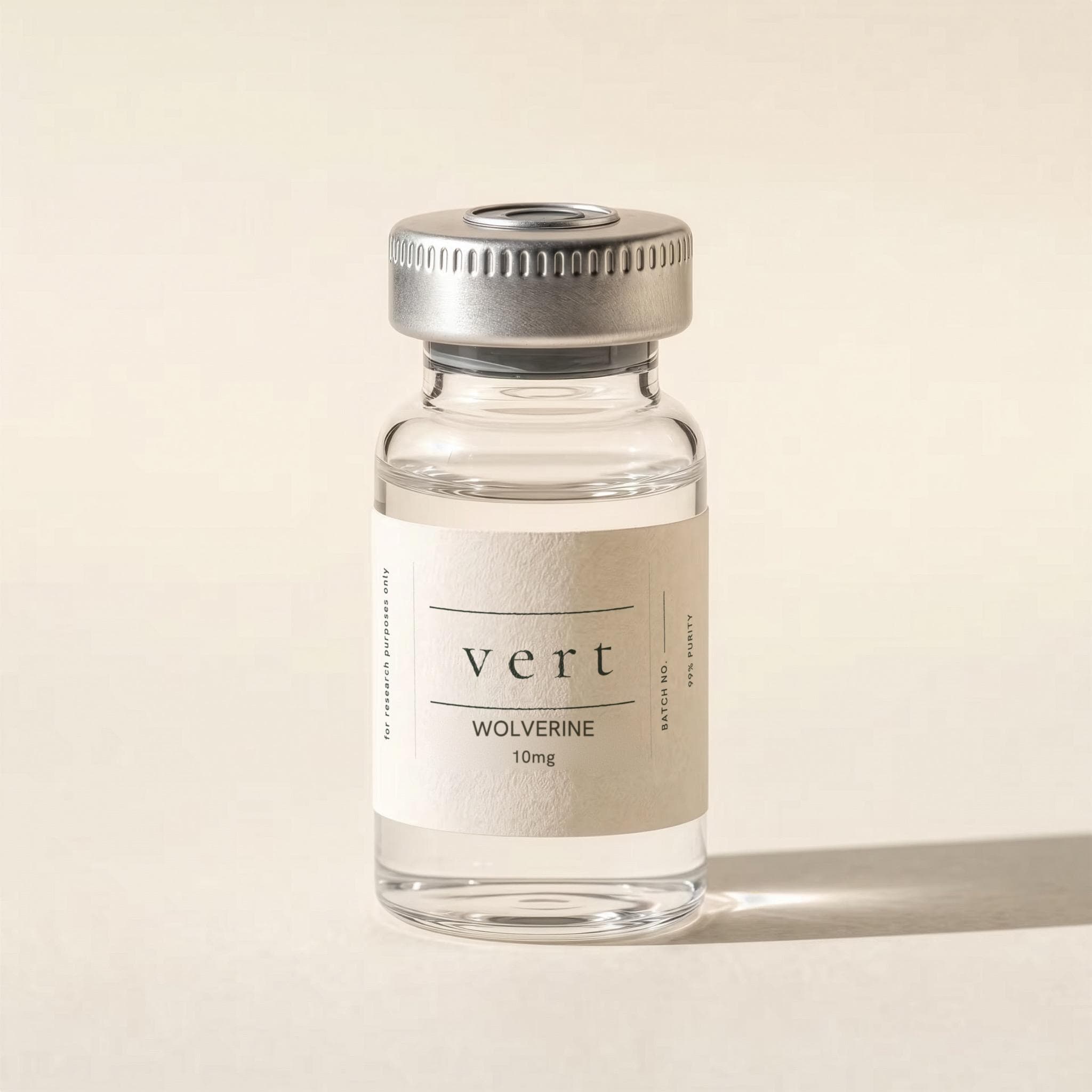
BPC-157 + TB-500 blend — 10mg (5mg + 5mg) or 20mg (10mg + 10mg)
Wolverine is v e r t's catalog name for a pre-mixed two-component blend of BPC-157 and TB-500 in equal mass, supplied as a lyophilized reference material in a 10mg vial (5mg plus 5mg) and a 20mg vial (10mg plus 10mg), with a certificate of analysis published for each size.
Wolverine is a catalog name, not a chemical one. It is not a registered substance name, and a mixture carries no registry number, no molecular formula and no molecular weight of its own; all three are properties of the individual species sharing the vial. What ships is two synthetic peptides pre-mixed in equal mass and lyophilized together, BPC-157 and TB-500, at 5mg of each in the 10mg size and 10mg of each in the 20mg size. Identity on this page is therefore built one component at a time, and the specification table carries a separate formula, mass, PubChem CID and InChIKey for each. BPC-157 is a synthetic pentadecapeptide, a fifteen-residue sequence. Its molecular formula is C62H98N16O22 at 1419.5 g/mol, PubChem CID 9941957, InChIKey HEEWEZGQMLZMFE-RKGINYAYSA-N. TB-500 is catalogued here as a thymosin beta-4 active fragment, and the identity figures recorded against it are those of full-length thymosin beta-4 rather than of the shorter Ac-LKKTETQ sequence that also trades under the TB-500 name: formula C212H350N56O78S at 4963 g/mol, PubChem CID 45382195, InChIKey UGPMCIBIHRSCBV-UHFFFAOYSA-N. That single sulfur atom in the thymosin beta-4 formula is the only one anywhere in the vial; the BPC-157 formula carries none. Because the two formula masses differ by a factor near 3.5, an equal-mass pairing is not an equimolar one. On the masses above, 5mg of BPC-157 is roughly 3.52 micromoles and 5mg of TB-500 roughly 1.01 micromoles, a molar ratio near 3.50 to 1, or about 78 percent to 22 percent by molecule count, from a mixture that is exactly half and half by mass. The 20mg size doubles both figures and leaves the ratio unchanged. Any statement of that kind is conditional on which thymosin beta-4 species the TB-500 mass corresponds to. Supplied as a lyophilized reference material, a white lyophilized powder in both sizes, in a sealed vial. Identity and purity are characterized by ultra-high-performance liquid chromatography with mass spectrometry, against a purity specification of 98 percent minimum for each component, and a certificate of analysis is published for each size. Stored desiccated at 68°F (20°C), away from light and moisture. It is not supplied as a solution, a suspension or any other prepared formulation, and no preparation guidance accompanies it.
>99% UPLC purity; identity confirmed by mass spectrometry. A Certificate of Analysis is published for each size, reporting that lot's identity and purity result. See our quality & COA page.
Supplied as a lyophilized reference material. Lyophilized reference materials are stored desiccated at 68°F (20°C), away from light and moisture. We do not provide reconstitution, preparation, or usage instructions of any kind.
Two synthetic peptides, pre-mixed in equal mass and lyophilized together in a single vial: BPC-157 and TB-500. The 10mg size holds 5mg of BPC-157 with 5mg of TB-500. The 20mg size holds 10mg of each. Wolverine is v e r t's catalog name for that pairing rather than the name of a chemical species; it is a product name, not a registered substance name. Because both sizes are mixed one to one by mass, the only difference between them is total quantity, which is why the two sizes carry the same identity data and a separate certificate each.
No. A CAS registry number, a molecular formula and a molecular weight each describe one chemical species, and a pre-mixed blend is two species sharing a vial, so it inherits none of the three. Any listing that prints a single formula or a single mass against a two-component product is describing one of the two components, not the mixture, and that substitution is the most common identity error on blend listings. Read identity here one component at a time. BPC-157 is C62H98N16O22 at 1419.5 g/mol, PubChem CID 9941957, InChIKey HEEWEZGQMLZMFE-RKGINYAYSA-N. The TB-500 component is catalogued against the thymosin beta-4 figures, C212H350N56O78S at 4963 g/mol, PubChem CID 45382195, InChIKey UGPMCIBIHRSCBV-UHFFFAOYSA-N. No CAS registry number is recorded for either component on this page, and none is asserted.
Because there is nothing to list for the blend. Mixing creates no new substance here: the two peptides do not react with one another to form a third species with a formula of its own, so the vial holds exactly what went into it. Registry numbers are assigned to substances, and a physical mixture of two registered substances is not itself registered. The same logic runs through the analytics. A chromatographic purity figure is the integrated area of one resolved peak divided by total integrated peak area, so a two-component sample resolves as two main peaks and cannot be reduced to a single honest blend purity number. Listing per component is the only description that survives that arithmetic, and it lets a reader compare the BPC-157 in this vial against the standalone BPC-157 listing on identical terms.
A certificate is published for each size, at /coa/wolverine-10mg.pdf and /coa/wolverine-20mg.pdf, and each document carries the date its own analysis was conducted. The method is qualitative and quantitative chemical analysis by ultra-high-performance liquid chromatography with mass spectrometry, and the purity specification is 98 percent minimum for each of the two components. Chromatographic purity is an area-percent figure, a relative measure of chromatographically resolved organic impurities rather than an assay of absolute content, and it does not account for water, residual solvent, counter-ion mass, or any species that neither retains on the column nor absorbs at the detection wavelength. This page states the specification rather than a measured figure, because a measured figure belongs to the lot the document was written for. Read the certificate published for the size in hand, and treat anything absent from that document as not certified by it.
Not here, and the gap is wide. Equal mass is equal molecule count only when the two species weigh the same, and these do not: TB-500 is catalogued against a formula mass about 3.50 times that of BPC-157, 4963 g/mol against 1419.5 g/mol. Worked through for the 10mg size, 5mg of BPC-157 at 1419.5 g/mol is about 3.52 micromoles and 5mg of TB-500 at 4963 g/mol is about 1.01 micromoles, a molar ratio near 3.50 to 1. That is roughly 78 percent BPC-157 and 22 percent TB-500 by molecule count, from a mixture that is exactly 50 percent each by mass. The 20mg size doubles both quantities and leaves the ratio identical. The arithmetic is conditional on the TB-500 mass used, which here is the full-length thymosin beta-4 mass rather than that of the shorter sequence.
TB-500 trades under two different structures across the category, which is why the recorded mass matters. Some listings use TB-500 to mean full-length thymosin beta-4; others use it to mean the shorter Ac-LKKTETQ sequence drawn from that protein. The two are not interchangeable and they do not weigh anything close to the same. The figures this catalog records for the TB-500 component are C212H350N56O78S at 4963 g/mol, filed under PubChem CID 45382195 for thymosin beta-4, which is the full-length species. That is the species the mass corresponds to and it is the only claim this page makes on the point. A listing elsewhere quoting a far smaller mass under the same TB-500 name is describing the shorter sequence, not this material. No CAS registry number is recorded for the TB-500 component, and none is asserted here.
Wolverine ships as a dry lyophilized reference material in a sealed vial, in two sizes: 10mg total, being 5mg of BPC-157 with 5mg of TB-500, and 20mg total, being 10mg of each. Lyophilization is freeze-drying, water removed by sublimation from the frozen state under reduced pressure, which leaves a porous cake or powder rather than a compacted solid. The appearance recorded for both sizes is a white lyophilized powder. Storage is desiccated at 68°F (20°C), away from light and moisture. It is not supplied as a solution, a suspension, or any other prepared formulation, and no preparation guidance accompanies it. Each size is analyzed separately and carries its own certificate.
FOR RESEARCH & EDUCATIONAL PURPOSES ONLY